
The Rosy-faced Lovebird (*Agapornis roseicollis*) is a small, colorful parrot native to arid regions of southwestern Africa. Known for their vibrant plumage and strong pair bonds, these birds are popular in aviculture and fascinating to observe in the wild. They play a role in seed dispersal in their native environment and are highly social, often seen in small flocks. While not globally threatened, localized populations can be impacted by habitat changes and trapping for the pet trade.
Photos of Rosy-faced Lovebird
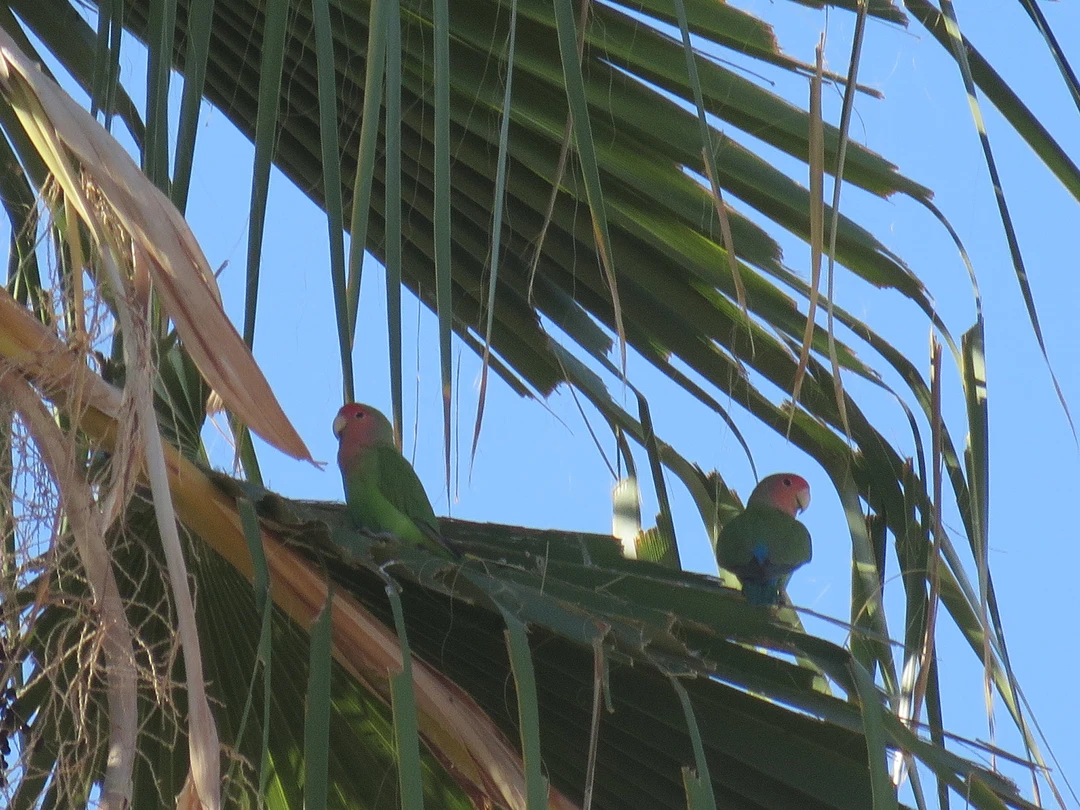
Compare plumage, posture, and field context across this image set.
Rosy-faced Lovebird sounds
Listen to a small selection of reference recordings.
About the Rosy-faced Lovebird
The Rosy-faced Lovebird (*Agapornis roseicollis*) is a small, colorful parrot native to arid regions of southwestern Africa. Known for their vibrant plumage and strong pair bonds, these birds are popular in aviculture and fascinating to observe in the wild. They play a role in seed dispersal in their native environment and are highly social, often seen in small flocks. While not globally threatened, localized populations can be impacted by habitat changes and trapping for the pet trade.
Also known as: Peach-faced Lovebird.
Scientific classification
Phylum: Chordata
Clazz: Aves
Order: Psittaciformes
Family: Psittacidae
Genus: Agapornis
Species: Agapornis roseicollis
Habitat and distribution
Adaptations: Rosy-faced Lovebirds are well-adapted to arid environments. They can obtain much of their water needs from their food and are efficient at conserving water. They are also strong fliers, capable of covering significant distances to find food and water.
Variations: Two subspecies are generally recognized: *A. r. roseicollis* and *A. r. catumbella*. The latter is found in a more restricted range in southwestern Angola and is distinguished by slightly darker plumage.
Distribution: Native to southwestern Africa, specifically Angola, Namibia, and parts of South Africa. They inhabit dry, open country, including savannah, woodlands, and rocky areas, often near water sources. They are not known for long-distance migrations but may move locally in response to food and water availability.
Habitat Types: Dry Savannah, Woodlands, Rocky areas near water, Semi-desert
Climate Zones: Arid, Semi-arid, Subtropical
Diet and feeding
Primary foods: Seeds, Fruits, Berries, Flowers, Occasionally insects
Foraging behavior: Rosy-faced Lovebirds forage in flocks, primarily on the ground but also in trees and shrubs. They are agile climbers and use their beaks and feet to manipulate food items.
Seasonal diet variations: Diet may vary depending on the availability of food sources throughout the year. During the dry season, they may rely more heavily on seeds, while fruits and flowers may be more important during the wet season.
Specializations: Their strong, hooked beak is well-suited for cracking open seeds and nuts.
Reproduction and lifecycle
Breeding season: Breeding typically occurs during the rainy season, which varies depending on the specific region. In some areas, breeding may occur year-round if conditions are favorable.
Regional variations: Breeding season is primarily linked to rainfall patterns, so it varies across their range.
Courtship rituals: Courtship involves mutual preening, feeding, and vocalizations. Males may perform head-bobbing displays and offer food to the female.
Nest Type: Nest in tree cavities, rock crevices, or sometimes in the nests of other birds, such as Sociable Weavers.
Nesting Materials: Strips of bark, Leaves, Other plant material
Parental care: Both parents participate in incubating the eggs and feeding the chicks. The female typically incubates the eggs, while the male provides food.
Fledging period: Approximately 6 weeks until first flight.
Clutch Size: 4-6 eggs
Physical characteristics
Sex-Based Plumage Differences: Minimal
Length: 15-18 cm
Wingspan: 9-11 cm
Weight: 40-60 g
Lifespan: 10-15 years in the wild; up to 20 years or more in captivity.
Breeding Plumage: Plumage remains relatively consistent throughout the year.
Seasonal Feather Changes: No significant seasonal variations.
Notable features: Bright rosy-red face and throat, Green body plumage, Blue rump, Short, hooked beak
Interesting facts
Unique nesting material transport.: Females carry nesting material tucked into their rump feathers, a behavior unique among parrots.
Strong pair bonds.: Rosy-faced Lovebirds are known for their strong pair bonds, which often last for life.
They are agile climbers.: They use their beaks and feet to navigate branches and access food with great dexterity.
Frequently asked questions
Are Rosy-faced Lovebirds good pets?
They can be affectionate and entertaining pets, but they require significant attention, socialization, and a stimulating environment. They can also be quite noisy.
What is the lifespan of a Rosy-faced Lovebird?
They can live for 10-15 years in the wild and up to 20 years or more in captivity with proper care.
Do Rosy-faced Lovebirds talk?
They are not known for their talking ability, although they can mimic some sounds and words. Their vocalizations are primarily chirps and screeches.
Can Rosy-faced lovebirds from different subspecies interbreed?
Yes, the two recognized subspecies, *A. r. roseicollis* and *A. r. catumbella*, can interbreed, and often do where their ranges overlap or in captive situations. This results in offspring with intermediate characteristics.
Compare the image, sound, habitat, and physical characteristics together when reviewing a sighting.