
The Red Crossbill (Loxia curvirostra) is a fascinating and unique species of finch, renowned for its distinctive crossed bill, an adaptation perfectly suited for extracting seeds from conifer cones. This specialized feeding behavior makes them highly dependent on coniferous forests and drives their nomadic movements, often irrupting into new areas in search of abundant cone crops. They play a crucial role in their ecosystem by dispersing seeds and influencing forest regeneration. While not typically considered a bird with significant cultural symbolism, their unusual appearance and erratic movements have long intrigued birdwatchers and ornithologists.
Photos of Red Crossbill
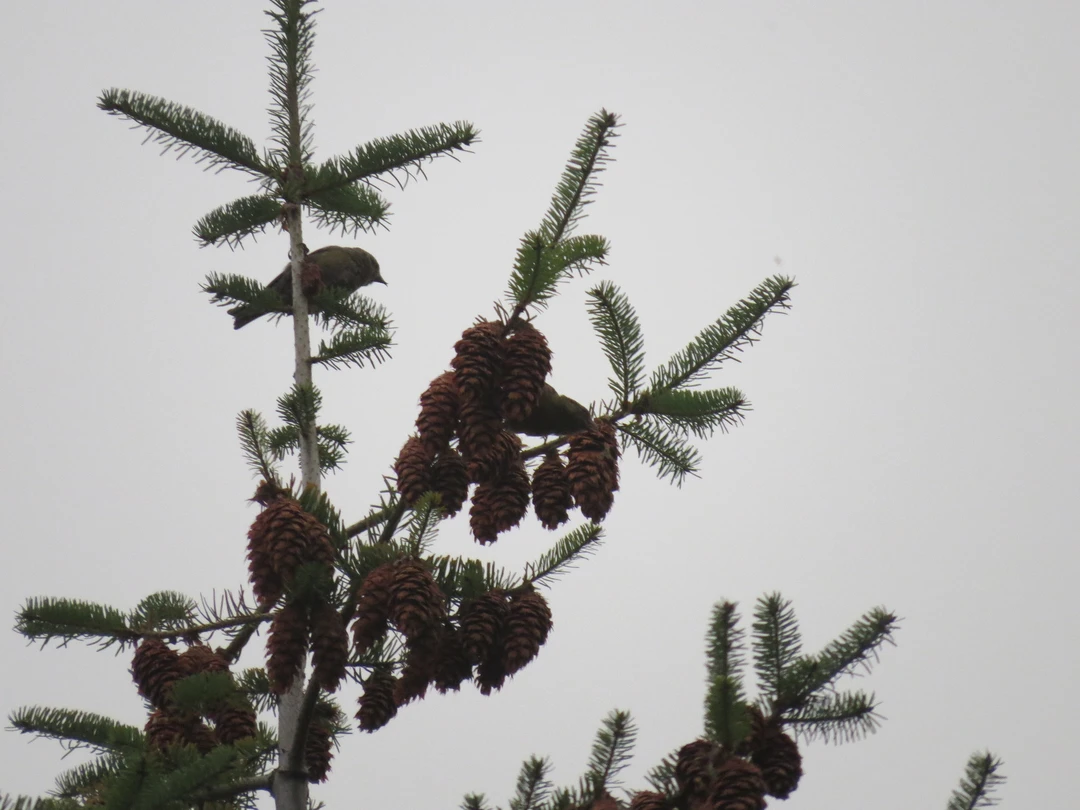
Compare plumage, posture, and field context across this image set.
Red Crossbill sounds
Listen to a small selection of reference recordings.
About the Red Crossbill
The Red Crossbill (Loxia curvirostra) is a fascinating and unique species of finch, renowned for its distinctive crossed bill, an adaptation perfectly suited for extracting seeds from conifer cones. This specialized feeding behavior makes them highly dependent on coniferous forests and drives their nomadic movements, often irrupting into new areas in search of abundant cone crops. They play a crucial role in their ecosystem by dispersing seeds and influencing forest regeneration. While not typically considered a bird with significant cultural symbolism, their unusual appearance and erratic movements have long intrigued birdwatchers and ornithologists.
Also known as: Common Crossbill.
Scientific classification
Phylum: Chordata
Clazz: Aves
Order: Passeriformes
Family: Fringillidae
Genus: Loxia
Species: Loxia curvirostra
Habitat and distribution
Adaptations: Their crossed bill is the primary adaptation to their habitat, allowing them to efficiently pry open conifer cones and extract seeds. Their strong feet and legs enable them to hang upside down while feeding.
Variations: Numerous subspecies of Red Crossbill have been identified, differing in bill size and shape, vocalizations, and preferred conifer species. These variations reflect adaptations to specific cone types found in different regions. The exact number of subspecies is debated, with some suggesting as many as nine distinct types in North America alone.
Distribution: Red Crossbills are widely distributed across the Northern Hemisphere, inhabiting coniferous forests in North America, Europe, and Asia. Their range extends from Alaska and Canada, south through the western United States and into Mexico. In Eurasia, they are found from Scandinavia and the British Isles, east across Russia to Siberia and Japan, and south to the mountainous regions of Central Asia. They are known for their irruptive migrations, moving unpredictably in response to cone crop availability.
Habitat Types: Coniferous forests, Mixed woodlands (with significant conifer presence)
Climate Zones: Temperate, Boreal, Montane
Diet and feeding
Primary foods: Conifer seeds (pine, spruce, fir, hemlock)
Foraging behavior: Red Crossbills use their specialized bills to pry open conifer cones. They insert the crossed tips between the cone scales and then twist or lever them apart, using their tongue to extract the seeds. They often forage in flocks, moving through the canopy in search of cones.
Seasonal diet variations: Their diet is almost entirely dependent on the availability of conifer seeds. While they may occasionally consume insects or buds, particularly during the breeding season, seeds remain their staple food year-round. The specific species of conifer seeds consumed varies depending on location and cone crop abundance.
Specializations: The crossed bill is a unique adaptation that allows them to access a food source largely unavailable to other birds with straight bills. Different bill sizes and shapes are specialized for different conifer species.
Reproduction and lifecycle
Breeding season: Breeding is closely tied to food availability and can occur at any time of year when cone crops are abundant. However, there is often a peak in late winter and early spring.
Regional variations: Breeding timing can vary significantly across their range, depending on local cone production cycles.
Courtship rituals: Courtship involves the male feeding the female, singing, and performing flight displays.
Nest Type: Cup-shaped nest, typically built on a horizontal branch high in a conifer tree.
Nesting Materials: Twigs, Grass, Moss, Lichen, Animal hair
Parental care: The female incubates the eggs for about 12-16 days. Both parents feed the chicks regurgitated seeds. The male may also feed the incubating female.
Fledging period: Approximately 15-25 days after hatching.
Clutch Size: Typically 3-5 eggs.
Physical characteristics
Sex-Based Plumage Differences: Minimal
Length: 14-20 cm
Wingspan: 27-30 cm
Weight: 25-40 g
Lifespan: Up to 8 years in the wild, though average lifespan is likely shorter.
Breeding Plumage: Males are generally brick-red or reddish-orange, while females are typically olive-green to yellowish. Juveniles are streaked brown.
Seasonal Feather Changes: Plumage coloration can fade slightly outside of the breeding season, but there are no dramatic seasonal changes.
Notable features: Crossed bill tips, Strong, stout bill, Relatively short, forked tail
Interesting facts
The direction of the bill crossing (left over right or right over left) is roughly equally distributed in the population.: This variation may help reduce competition, as individuals with different bill crossings might be able to access seeds from different parts of the cone.
Red Crossbills can breed even in winter, as long as there is a sufficient cone crop.: This unusual breeding behavior is a direct adaptation to their reliance on conifer seeds.
Different 'types' of Red Crossbills, distinguished by their calls and bill sizes, often specialize on different conifer species.: This specialization may be driving the evolution of new species within the Red Crossbill complex.
Frequently asked questions
Why do crossbills have crossed bills?
Their crossed bills are a specialized adaptation for extracting seeds from conifer cones, allowing them to access a food source that most other birds cannot.
Where can I see Red Crossbills?
Look for them in coniferous forests, particularly during times of abundant cone crops. Their presence in a particular area can be unpredictable, as they move around in search of food.
Are Red Crossbills endangered?
Red Crossbills are currently classified as 'Least Concern' by the IUCN, meaning they are not considered to be at immediate risk of extinction. However, habitat loss and climate change pose potential long-term threats.
Do Red Crossbills migrate?
They are nomadic and irruptive, moving in response to food availability rather than following a fixed migratory route.
Compare the image, sound, habitat, and physical characteristics together when reviewing a sighting.