
The Northern Saw-whet Owl (Aegolius acadicus) is a small, secretive owl native to North America. It's named for the male's unique breeding call, which is said to resemble the sound of a saw being sharpened on a whetstone. These owls play a crucial role in controlling rodent populations within their forest ecosystems. They are not typically considered culturally significant in the same way as larger, more imposing owl species, but their elusiveness and charming appearance have made them a favorite among birdwatchers.
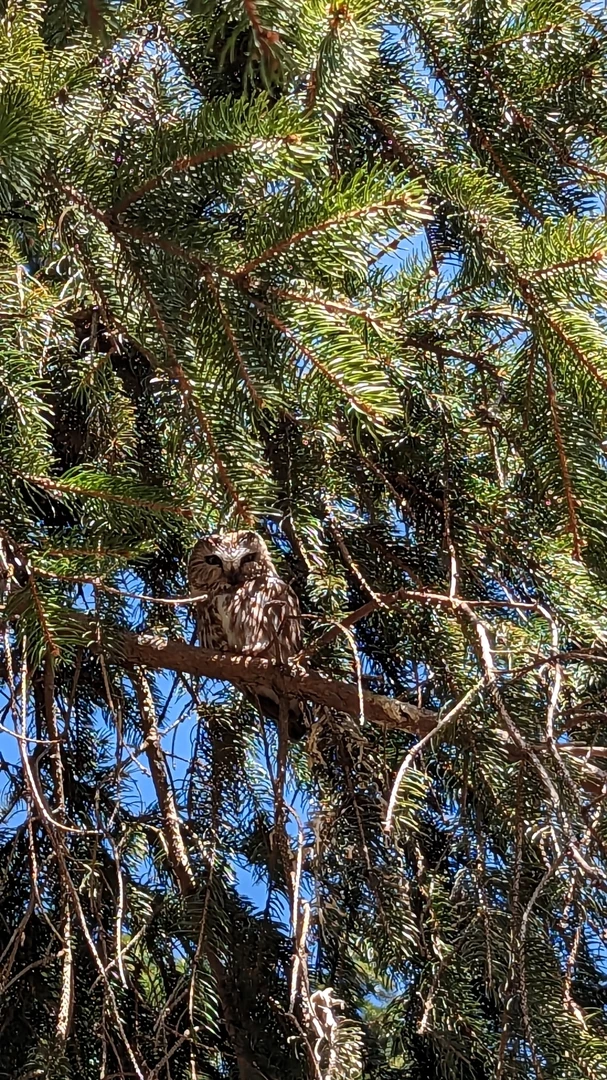
Photos of Northern Saw-whet Owl
Compare plumage, posture, and field context across this image set.
Northern Saw-whet Owl sounds
Listen to a small selection of reference recordings.
About the Northern Saw-whet Owl
The Northern Saw-whet Owl (Aegolius acadicus) is a small, secretive owl native to North America. It's named for the male's unique breeding call, which is said to resemble the sound of a saw being sharpened on a whetstone. These owls play a crucial role in controlling rodent populations within their forest ecosystems. They are not typically considered culturally significant in the same way as larger, more imposing owl species, but their elusiveness and charming appearance have made them a favorite among birdwatchers.
Also known as: Acadian Owl, Kirtland's Owl, Saw-filer, Whetsaw, Sparrow Owl, White-fronted Owl.
Scientific classification
Phylum: Chordata
Clazz: Aves
Order: Strigiformes
Family: Strigidae
Genus: Aegolius
Species: Aegolius acadicus
Habitat and distribution
Adaptations: Dense forests provide cover for roosting and nesting. Their excellent hearing allows them to hunt in low-light conditions within these habitats.
Variations: Two subspecies are generally recognized: *A. a. acadicus* (widespread) and *A. a. brooksi* (endemic to the Queen Charlotte Islands, British Columbia, and darker in coloration).
Distribution: Found across North America, from southern Alaska and Canada south to central Mexico. They are partially migratory, with northern populations moving south for the winter. Altitudinal range extends from sea level to high-elevation forests.
Habitat Types: Coniferous forests, Mixed woodlands, Riparian areas
Climate Zones: Temperate, Boreal
Diet and feeding
Primary foods: Small rodents (especially voles and mice), Shrews, Insects (occasionally)
Foraging behavior: Primarily nocturnal hunters, they use a 'sit-and-wait' strategy, perching on low branches and listening for prey. They locate prey primarily by sound.
Seasonal diet variations: Diet may shift slightly depending on prey availability; insects may be more common in summer, but rodents are the staple year-round.
Specializations: Asymmetrical ear openings allow for precise sound localization, enabling them to pinpoint prey even under snow or leaf litter.
Reproduction and lifecycle
Breeding season: Late winter to early summer (February-June), depending on location.
Regional variations: Breeding may start earlier in southern parts of the range.
Courtship rituals: Males give a repeated 'toot-toot-toot' call to attract females. Courtship feeding (male providing food to the female) also occurs.
Nest Type: Cavity nesters, using old woodpecker holes, natural tree cavities, or nest boxes.
Nesting Materials: Existing cavity debris, Feathers (sometimes)
Parental care: The female incubates the eggs for 27-29 days. The male provides food during incubation and brooding. Both parents feed the chicks after hatching.
Fledging period: Approximately 4-5 weeks until fledging.
Clutch Size: 4-7 eggs
Physical characteristics
Sex-Based Plumage Differences: Females are slightly larger.
Length: 17-22 cm
Wingspan: 42-48 cm
Weight: 65-110 g
Lifespan: Up to 7 years in the wild; longer in captivity (though data is limited).
Breeding Plumage: Plumage is generally consistent year-round, though it may appear slightly fresher after molting.
Seasonal Feather Changes: Minimal seasonal variation.
Notable features: Large, round head with no ear tufts., Bright yellow eyes., Facial disk that helps direct sound to their ears.
Interesting facts
They are one of the smallest owls in North America.: Their small size allows them to maneuver easily through dense forest undergrowth.
Their name comes from the male's breeding call.: The call is a series of whistled notes that some say sounds like a saw being sharpened.
They have asymmetrical ear openings.: This unique adaptation allows them to pinpoint the location of prey with incredible accuracy, even in complete darkness.
They can catch prey larger than themself: Usually catching smaller prey, the Northern Saw-whet Owl has been recorded catching and eating prey larger than itself.
Frequently asked questions
Are Northern Saw-whet Owls dangerous to humans?
No, they are small and non-aggressive towards humans. They pose no threat.
Where can I see a Northern Saw-whet Owl?
They are difficult to spot due to their nocturnal habits and excellent camouflage. Look for them in dense forests, often perched on low branches. Listening for their calls at night during the breeding season is another way to locate them.
What should I do if I find an injured Northern Saw-whet Owl?
Do not attempt to handle it yourself. Contact a local wildlife rehabilitator or veterinarian for assistance. *Consult a professional for expert advice.*
Do Northern Saw-whet Owls mate for life?
Northern Saw-whet Owls are not known to mate for life. They are known to have multiple partners.
Compare the image, sound, habitat, and physical characteristics together when reviewing a sighting.