
The Northern Cardinal (Cardinalis cardinalis) is a striking, medium-sized songbird native to North America. Renowned for the male's brilliant red plumage, it's a common sight at backyard feeders and a beloved symbol of many regions. Unlike many songbirds, both male and female cardinals sing, offering a variety of clear, whistled songs. Ecologically, they play a role in seed dispersal and insect control. The Northern Cardinal holds cultural significance as the state bird of seven US states, reflecting its widespread presence and popularity.
Photos of Northern Cardinal
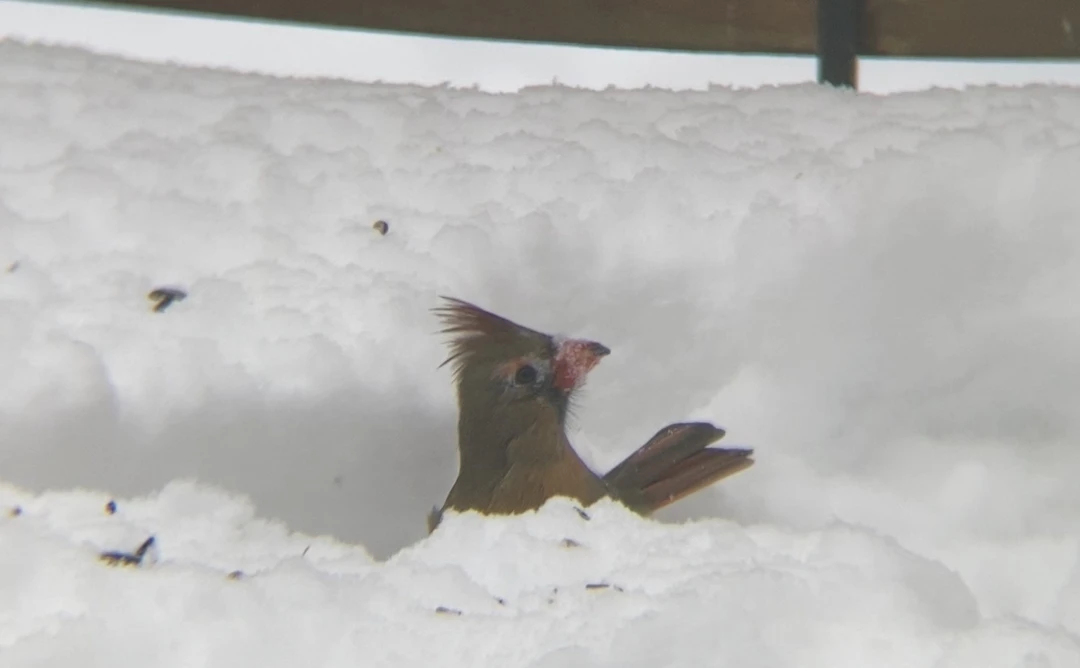
Compare plumage, posture, and field context across this image set.
Northern Cardinal sounds
Listen to a small selection of reference recordings.
About the Northern Cardinal
The Northern Cardinal (Cardinalis cardinalis) is a striking, medium-sized songbird native to North America. Renowned for the male's brilliant red plumage, it's a common sight at backyard feeders and a beloved symbol of many regions. Unlike many songbirds, both male and female cardinals sing, offering a variety of clear, whistled songs. Ecologically, they play a role in seed dispersal and insect control. The Northern Cardinal holds cultural significance as the state bird of seven US states, reflecting its widespread presence and popularity.
Also known as: Cardinal, Redbird, Red Cardinal, Cardinal-bird, Cardinal Grosbeak, Virginia Nightingale, Virginian Nightingale, Virginia Cardinal, Virginia Redbird, Crested Redbird, Top-knot Redbird, Cardinal Redbird, Common Cardinal, Red-bird.
Scientific classification
Phylum: Chordata
Clazz: Aves
Order: Passeriformes
Family: Cardinalidae
Genus: Cardinalis
Species: Cardinalis cardinalis
Habitat and distribution
Adaptations: Northern Cardinals are highly adaptable to varied habitats. Their strong, conical beaks are well-suited for cracking seeds, a staple food source, while their generalist diet allows them to thrive in diverse environments. They readily utilize human-altered landscapes, often frequenting bird feeders.
Variations: There are numerous recognized subspecies (around 19), varying slightly in size, bill shape, and plumage color intensity. These variations are often linked to geographic location, with some subspecies exhibiting brighter or duller coloration than others.
Distribution: Eastern and Central North America, ranging from southeastern Canada through the eastern United States, extending south into Mexico and parts of Central America. Introduced populations exist in Bermuda, Hawaii, and California. They are generally non-migratory, remaining in their territories year-round.
Habitat Types: Woodlands, Gardens, Parks, Shrublands, Thickets
Climate Zones: Temperate, Subtropical
Diet and feeding
Primary foods: Seeds, Fruits, Insects, Berries
Foraging behavior: Northern Cardinals forage on the ground, in shrubs, and in trees. They often hop along the ground searching for seeds and insects. They will also perch on branches to glean insects or pick berries.
Seasonal diet variations: Diet varies seasonally. Insects are more prevalent in the diet during the breeding season, providing protein for growing chicks. Seeds and fruits make up a larger proportion of the diet during the fall and winter.
Specializations: Their strong, conical bill is specialized for cracking seeds and crushing hard-shelled insects.
Reproduction and lifecycle
Breeding season: Primarily spring and summer, typically from March to September.
Regional variations: Breeding may start earlier in southern regions due to warmer temperatures.
Courtship rituals: Males court females by offering them food, singing, and engaging in a courtship display where they sway their body and raise their crest.
Nest Type: Cup-shaped nest built in dense shrubs or trees.
Nesting Materials: Twigs, Bark strips, Grass, Leaves, Rootlets
Parental care: Both parents participate in incubating the eggs (incubation lasts 11-13 days) and feeding the chicks. The female primarily broods the young, while the male provides most of the food.
Fledging period: 9-11 days after hatching.
Clutch Size: Typically 2-5 eggs.
Physical characteristics
Sex-Based Plumage Differences: Males are slightly larger on average.
Length: 21-23.5 cm
Wingspan: 25-31 cm
Weight: 33.6-65 g
Lifespan: Typically 3-5 years in the wild, although some individuals have been recorded living up to 15 years. Captive birds can live longer.
Breeding Plumage: Males retain their bright red plumage year-round. Females have a buff-brown body with reddish tinges on the wings, tail, and crest. Juveniles resemble females, with young males gradually acquiring their red plumage.
Seasonal Feather Changes: Minimal seasonal variation. Some individuals may exhibit slightly brighter plumage during the breeding season.
Notable features: Prominent crest, Black mask (males), Heavy, conical bill, Reddish-orange bill
Interesting facts
Both male and female Northern Cardinals sing.: This is relatively uncommon among North American songbirds, where males typically do most of the singing.
They are the state bird of seven US states.: This includes Illinois, Indiana, Kentucky, North Carolina, Ohio, Virginia, and West Virginia.
Cardinals sometimes engage in 'anting'.: They rub ants on their feathers, possibly to remove parasites or soothe skin irritation from the formic acid secreted by the ants.
Cardinals can see a wider color spectrum.: Unlike humans, cardinals can see ultraviolet light.
Frequently asked questions
What do I do if I find a baby cardinal?
If the bird is feathered and hopping, it's likely a fledgling learning to fly. It's best to leave it alone, as the parents are likely nearby. If it's unfeathered or injured, contact a local wildlife rehabilitator.
Why are cardinals attacking my windows?
They are likely seeing their reflection and perceiving it as a rival. Try breaking up the reflection with window decals, screens, or other deterrents.
What is the best food to attract cardinals?
Black oil sunflower seeds, safflower seeds, and white milo are good choices. They also enjoy suet and crushed peanuts.
How can I tell a male and female cardinal apart?
Males are bright red with a black mask, while females are buff-brown with reddish tinges.
Compare the image, sound, habitat, and physical characteristics together when reviewing a sighting.