
The Lesser Goldfinch (Spinus psaltria) is a small, vibrant songbird native to the Americas. Known for its bright yellow plumage and melodious song, it plays a crucial role in seed dispersal across its range. It's a common sight in gardens and open woodlands, adding a splash of color and cheerful sound. While not as widely recognized as some other finches, the Lesser Goldfinch holds a special place in the hearts of birdwatchers and contributes significantly to the ecological health of its environment. It has no specific major cultural significance, but its lively presence is appreciated by many.
Photos of Lesser Goldfinch
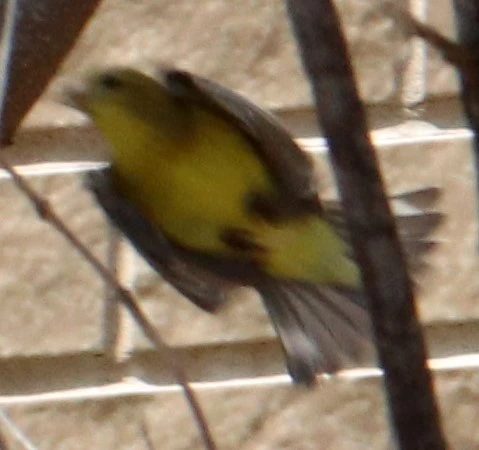
Compare plumage, posture, and field context across this image set.
Lesser Goldfinch sounds
Listen to a small selection of reference recordings.
About the Lesser Goldfinch
The Lesser Goldfinch (Spinus psaltria) is a small, vibrant songbird native to the Americas. Known for its bright yellow plumage and melodious song, it plays a crucial role in seed dispersal across its range. It's a common sight in gardens and open woodlands, adding a splash of color and cheerful sound. While not as widely recognized as some other finches, the Lesser Goldfinch holds a special place in the hearts of birdwatchers and contributes significantly to the ecological health of its environment. It has no specific major cultural significance, but its lively presence is appreciated by many.
Scientific classification
Phylum: Chordata
Clazz: Aves
Order: Passeriformes
Family: Fringillidae
Genus: Spinus
Species: Spinus psaltria
Habitat and distribution
Adaptations: Their small size and agility allow them to exploit a variety of seed sources, including those on thin, swaying stems. Their beaks are adapted for efficiently extracting seeds from thistles and other composite flowers.
Variations: Several subspecies are recognized, differing slightly in plumage and size. For example, *Spinus psaltria hesperophilus* is found along the Pacific coast and is known for its darker back in males, while *Spinus psaltria psaltria* is found in the interior southwestern US and Mexico.
Distribution: The Lesser Goldfinch is found from the southwestern United States through Mexico and Central America, extending into parts of South America, including Colombia, Venezuela, Ecuador and Peru. Some populations are resident, while others, particularly in the northern part of their range, are migratory, moving south for the winter. Altitudinal range varies from sea level to over 2,500 meters.
Habitat Types: Open woodlands, Scrublands, Gardens, Parks, Riparian areas
Climate Zones: Temperate, Subtropical, Tropical
Diet and feeding
Primary foods: Seeds, Insects (especially during breeding season), Small fruits
Foraging behavior: Lesser Goldfinches are primarily seed-eaters, foraging in small flocks, often clinging to seed heads of plants like thistles and sunflowers. They are acrobatic feeders, able to hang upside down to reach seeds.
Seasonal diet variations: During the breeding season, they consume more insects to provide protein for their growing young. In winter, they rely almost entirely on seeds.
Specializations: Their conical bill is well-suited for cracking small seeds. They have a particular fondness for seeds of the Asteraceae family (e.g., thistles, sunflowers).
Reproduction and lifecycle
Breeding season: Breeding season varies by location but generally occurs in late spring and summer, often timed with peak seed availability.
Regional variations: In some parts of their range, they may have two broods per year. In more tropical regions, breeding can occur year-round.
Courtship rituals: Males perform courtship displays that include singing, fluttering their wings, and offering food to the female.
Nest Type: A small, cup-shaped nest, usually placed in a shrub or tree.
Nesting Materials: Plant fibers, Spider silk, Downy plant material
Parental care: Both parents participate in feeding the young, although the female does most of the incubation. The young are fed a diet of regurgitated seeds and insects.
Fledging period: Approximately 11-15 days after hatching.
Clutch Size: 3-6 eggs
Physical characteristics
Sex-Based Plumage Differences: Minimal
Length: 9-12 cm
Wingspan: 15-20 cm
Weight: 8-11.5 g
Lifespan: Typically 3-4 years in the wild, although some individuals may live longer. Captive birds can live up to 7 years.
Breeding Plumage: Males in breeding plumage are bright yellow below and greenish to black above, with white wing patches. Non-breeding males are duller, with more olive coloration. Females are generally duller than males, lacking the strong black or green back.
Seasonal Feather Changes: Plumage is brightest during the breeding season (spring and summer). After breeding, birds molt into a duller, less conspicuous plumage.
Notable features: Small, conical bill, White wing patches, Black cap (in some subspecies), Forked tail
Interesting facts
Lesser Goldfinches are highly adaptable to human-altered landscapes.: They are frequent visitors to backyard bird feeders, especially those offering thistle (nyjer) seed.
They often line their nests with plant down.: This provides insulation and helps keep the eggs and chicks warm.
Their song is complex and variable.: Males can learn new song elements throughout their lives.
Frequently asked questions
What do I feed Lesser Goldfinches?
They are particularly fond of thistle (nyjer) seed, but will also eat sunflower seeds and other small seeds. Providing a variety of seeds is best.
How can I attract Lesser Goldfinches to my yard?
Provide a source of fresh water, plant native seed-bearing plants, and offer thistle seed in a feeder. Avoid using pesticides.
Are Lesser Goldfinches aggressive?
They are generally not aggressive towards other bird species, although males may defend their nesting territory during the breeding season.
Do Lesser Goldfinches mate for life?
Lesser Goldfinches are not known to mate for life. They typically form new pair bonds each breeding season.
Compare the image, sound, habitat, and physical characteristics together when reviewing a sighting.