
The Killdeer (Charadrius vociferus) is a medium-sized plover found throughout the Americas. It is known for its distinctive, loud call, from which it gets its name, and its characteristic "broken-wing" display used to distract predators from its nest. Unlike many shorebirds, Killdeer are often found far from water, inhabiting open habitats like fields, pastures, and even parking lots. They play an important ecological role as insectivores, helping to control populations of various invertebrates. While not typically considered culturally significant in the same way as some larger birds, their ubiquity and distinctive behavior have made them a familiar sight and sound to many.
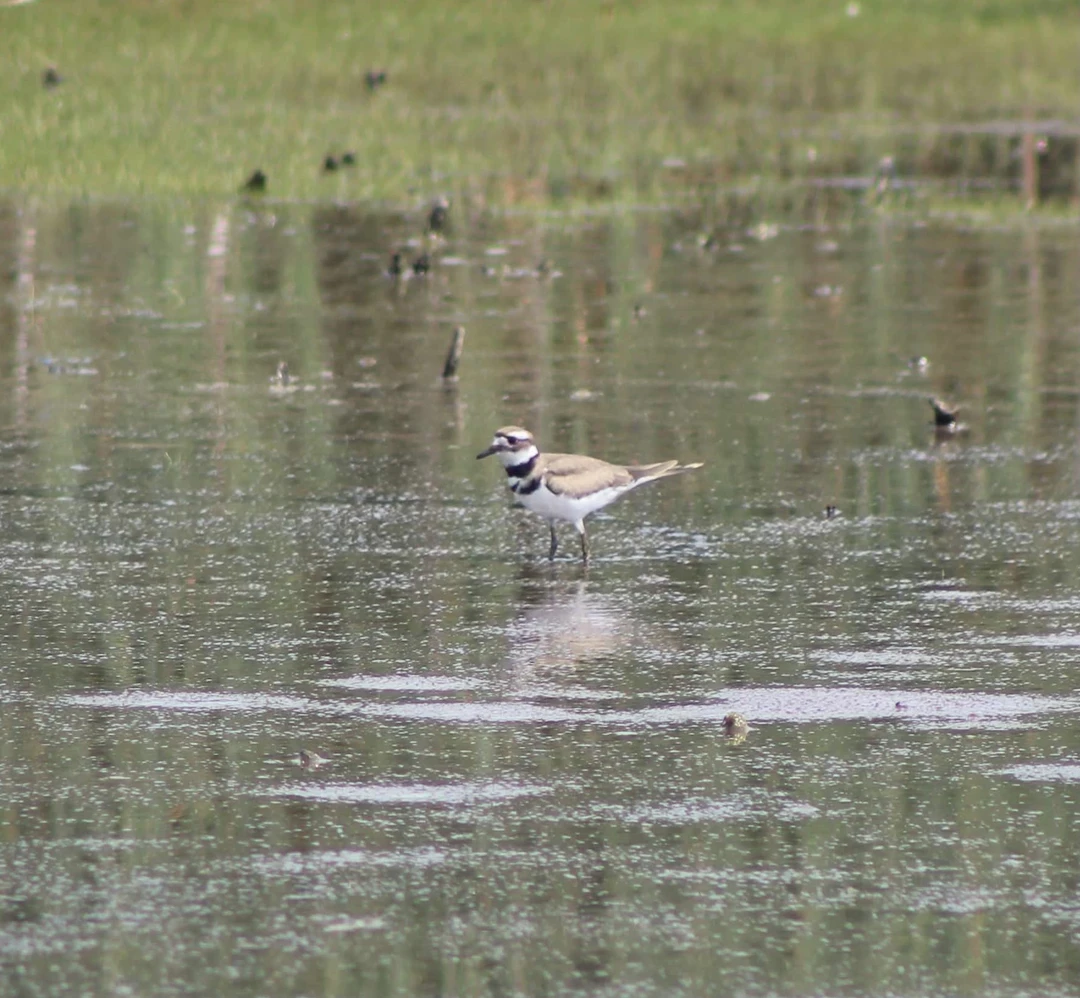
Photos of Killdeer
Compare plumage, posture, and field context across this image set.
Killdeer sounds
Listen to a small selection of reference recordings.
About the Killdeer
The Killdeer (Charadrius vociferus) is a medium-sized plover found throughout the Americas. It is known for its distinctive, loud call, from which it gets its name, and its characteristic "broken-wing" display used to distract predators from its nest. Unlike many shorebirds, Killdeer are often found far from water, inhabiting open habitats like fields, pastures, and even parking lots. They play an important ecological role as insectivores, helping to control populations of various invertebrates. While not typically considered culturally significant in the same way as some larger birds, their ubiquity and distinctive behavior have made them a familiar sight and sound to many.
Also known as: Kildeer, Kildeer Plover.
Scientific classification
Phylum: Chordata
Clazz: Aves
Order: Charadriiformes
Family: Charadriidae
Genus: Charadrius
Species: Charadrius vociferus
Habitat and distribution
Adaptations: Killdeer are well-adapted to open habitats. Their relatively long legs allow them to run quickly across the ground, and their countershaded plumage (dark above, light below) provides camouflage in open areas. They are highly adaptable and can tolerate human-modified landscapes.
Variations: Several subspecies are recognized, differing slightly in size and plumage coloration. For example, *C. v. ternominatus* is found in the Bahamas and Greater Antilles, and *C. v. peruvianus* is found in Peru and Chile.
Distribution: The Killdeer's range extends from southern Alaska and Canada, across the United States, and down through Mexico, Central America, and parts of South America, including the Caribbean. They are migratory in the northern parts of their range, moving south for the winter. Altitudinally, they can be found from sea level to high-elevation grasslands.
Habitat Types: Grasslands, Fields, Pastures, Mudflats, Shorelines, Gravel bars, Golf courses, Airports
Climate Zones: Temperate, Subtropical, Tropical
Diet and feeding
Primary foods: Insects, Spiders, Earthworms, Snails, Other invertebrates, Occasionally small seeds
Foraging behavior: Killdeer primarily forage by running, stopping, and then pecking at the ground. They often use a foot-trembling technique to stir up prey in shallow water or mud.
Seasonal diet variations: Diet composition may shift slightly depending on prey availability, with a greater reliance on insects during the breeding season.
Specializations: Their relatively long bill is well-suited for probing in soft substrates. Their visual acuity is also important for spotting prey.
Reproduction and lifecycle
Breeding season: Breeding season varies geographically, but generally occurs in spring and summer (March-August in North America).
Regional variations: In southern parts of the range, breeding may occur earlier or even year-round.
Courtship rituals: Courtship involves aerial displays, calling, and scraping on the ground to create potential nest sites. The male may also perform a "scrape ceremony" where he lowers his breast to the ground and fans his tail.
Nest Type: A shallow scrape on the ground, often lined with small pebbles, twigs, or other debris.
Nesting Materials: Pebbles, Twigs, Shells, Plant material
Parental care: Both parents incubate the eggs for 24-28 days. The chicks are precocial, meaning they are able to walk and feed themselves shortly after hatching. Both parents care for the chicks, leading them to foraging areas and protecting them from predators.
Fledging period: Chicks fledge (gain the ability to fly) at around 25-30 days.
Clutch Size: Typically 3-5 eggs.
Physical characteristics
Sex-Based Plumage Differences: Minimal
Length: 20-28 cm
Wingspan: 45-60 cm
Weight: 75-125 g
Lifespan: Up to 10 years in the wild, although average lifespan is likely shorter.
Breeding Plumage: Plumage is generally similar year-round, though breeding birds may have slightly brighter colors.
Seasonal Feather Changes: Minimal seasonal variation.
Notable features: Two black breast bands, Brown back and wings, White belly, Orange-rufous rump visible in flight, Red eye-ring
Interesting facts
Killdeer are known for their "broken-wing" display.: This distraction display is used to lure predators away from the nest or chicks. The bird will run away from the nest, dragging one or both wings as if injured, and making distress calls.
They often nest in seemingly unsuitable locations.: Killdeer have been known to nest on gravel rooftops, in parking lots, and other human-altered habitats. This can make them vulnerable to disturbance and nest destruction.
Killdeer chicks are precocial.: This means they are relatively mobile and independent soon after hatching, able to walk and forage with minimal parental assistance.
Killdeer have been observed using tools.: There are a few documented observations that suggest Killdeer use pieces of bread or insects as bait to lure fish closer.
Frequently asked questions
What should I do if I find a Killdeer nest?
Leave it undisturbed. Killdeer are protected by law, and it is illegal to harm them or their nests. Observe from a distance and avoid approaching too closely.
Why is a Killdeer doing a "broken-wing" display?
It is likely trying to distract you from its nest or chicks. Move away from the area, and the bird should stop the display.
Do Killdeer migrate?
Yes, northern populations migrate south for the winter. Southern populations may be resident year-round.
What do Killdeer eat?
They primarily eat insects and other invertebrates, which they find by probing in the ground or picking from the surface.
Compare the image, sound, habitat, and physical characteristics together when reviewing a sighting.