
The Jungle Babbler (*Argya striata*) is a member of the Leiothrichidae family, commonly found across the Indian subcontinent. These birds are renowned for their social behavior, often seen foraging in small groups, earning them the nickname "Seven Sisters" or "Saath bhai" in some regions. They play a crucial role in their ecosystem as seed dispersers and insect controllers. Their constant chatter and communal activities make them a distinctive presence in their habitat. They are not globally threatened, but localized habitat loss can impact their populations.
Photos of Jungle Babbler
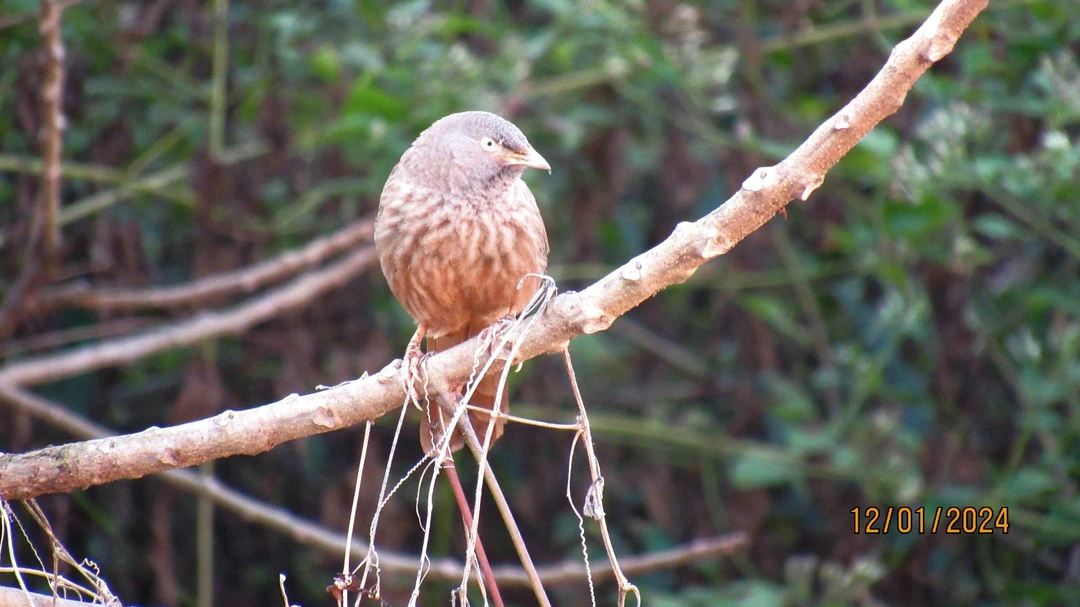
Compare plumage, posture, and field context across this image set.
About the Jungle Babbler
The Jungle Babbler (*Argya striata*) is a member of the Leiothrichidae family, commonly found across the Indian subcontinent. These birds are renowned for their social behavior, often seen foraging in small groups, earning them the nickname "Seven Sisters" or "Saath bhai" in some regions. They play a crucial role in their ecosystem as seed dispersers and insect controllers. Their constant chatter and communal activities make them a distinctive presence in their habitat. They are not globally threatened, but localized habitat loss can impact their populations.
Scientific classification
Phylum: Chordata
Clazz: Aves
Order: Passeriformes
Family: Leiothrichidae
Genus: Turdoides
Species: Argya striata
Habitat and distribution
Adaptations: They are well-adapted to living in dense undergrowth, with strong legs for hopping on the ground and short, rounded wings for quick maneuvering through vegetation.
Variations: Several subspecies are recognized, differing slightly in plumage coloration and size across their range. For instance, *Argya striata striata* is found in parts of India, while other subspecies inhabit different regions.
Distribution: Primarily found throughout the Indian subcontinent, including India, Pakistan, Bangladesh, Nepal, and Sri Lanka. They are non-migratory but may make local movements in response to food availability.
Habitat Types: Dry deciduous forests, Scrublands, Agricultural areas, Urban gardens
Climate Zones: Tropical, Subtropical
Diet and feeding
Primary foods: Insects, Spiders, Small invertebrates, Berries, Seeds, Nectar
Foraging behavior: Forages primarily on the ground, hopping and scratching through leaf litter and low vegetation. Often forages in groups, maintaining vocal contact.
Seasonal diet variations: Diet may shift slightly depending on the availability of food. For example, they may consume more fruits and berries during fruiting seasons.
Specializations: Their strong legs and bill are adapted for probing and turning over leaves and small objects to find prey.
Reproduction and lifecycle
Breeding season: Breeding season varies across their range but generally occurs from March to September, often coinciding with the monsoon season.
Regional variations: In some regions, breeding may extend throughout the year if conditions are favorable.
Courtship rituals: Courtship involves mutual preening, chasing, and vocalizations. Groups may engage in cooperative breeding.
Nest Type: Cup-shaped nest built in a bush or low tree.
Nesting Materials: Twigs, Grass, Roots, Leaves
Parental care: Both parents, and sometimes other group members, participate in nest building, incubation, and feeding the young. This cooperative breeding is a hallmark of their social structure.
Fledging period: Chicks fledge approximately 15-20 days after hatching.
Clutch Size: Typically 3-5 eggs.
Physical characteristics
Sex-Based Plumage Differences: No significant difference
Length: 22-25 cm
Wingspan: 28-31 cm
Weight: 65-80 g
Lifespan: Average lifespan in the wild is not well documented but is estimated to be around 5-7 years. Captive birds may live longer.
Breeding Plumage: No significant difference between breeding and non-breeding plumage.
Seasonal Feather Changes: Minimal seasonal variation.
Notable features: Greyish-brown overall plumage with streaked appearance., Pale yellowish bill., Orange-yellow eyes., Dark lores (area between the eye and bill).
Interesting facts
They are known for their cooperative breeding behavior.: Multiple individuals within a group assist in raising the young, not just the breeding pair.
They are often referred to as "Seven Sisters.": This nickname stems from their habit of foraging in groups of around seven individuals.
They are important seed dispersers.: By consuming fruits and berries, they help distribute seeds throughout their habitat.
Frequently asked questions
Are Jungle Babblers aggressive?
They are not typically aggressive towards humans. However, they are territorial and will defend their group's territory against other babblers.
What is the purpose of their constant chattering?
The chattering serves multiple purposes, including maintaining group cohesion, warning of danger, and coordinating foraging activities.
Do Jungle Babblers migrate?
No, they are resident birds and do not undertake long-distance migrations.
Can I keep a Jungle Babblers as pets?
It is not recommended and often illegal without permits. They are wild birds and important to the ecosystem.
Compare the image, sound, habitat, and physical characteristics together when reviewing a sighting.