
The Japanese Pygmy Woodpecker (*Yungipicus kizuki*) is a small woodpecker species found in Japan, Korea, and parts of eastern Russia and northeastern China. It plays a crucial role in its forest ecosystem by controlling insect populations, and its presence is often an indicator of a healthy woodland environment. Unlike many woodpeckers, it doesn't excavate large cavities, preferring smaller holes in decaying wood. It is not particularly known for significant cultural importance, but it is a welcomed and familiar sight in Japanese woodlands and gardens.
Photos of Japanese Pygmy Woodpecker
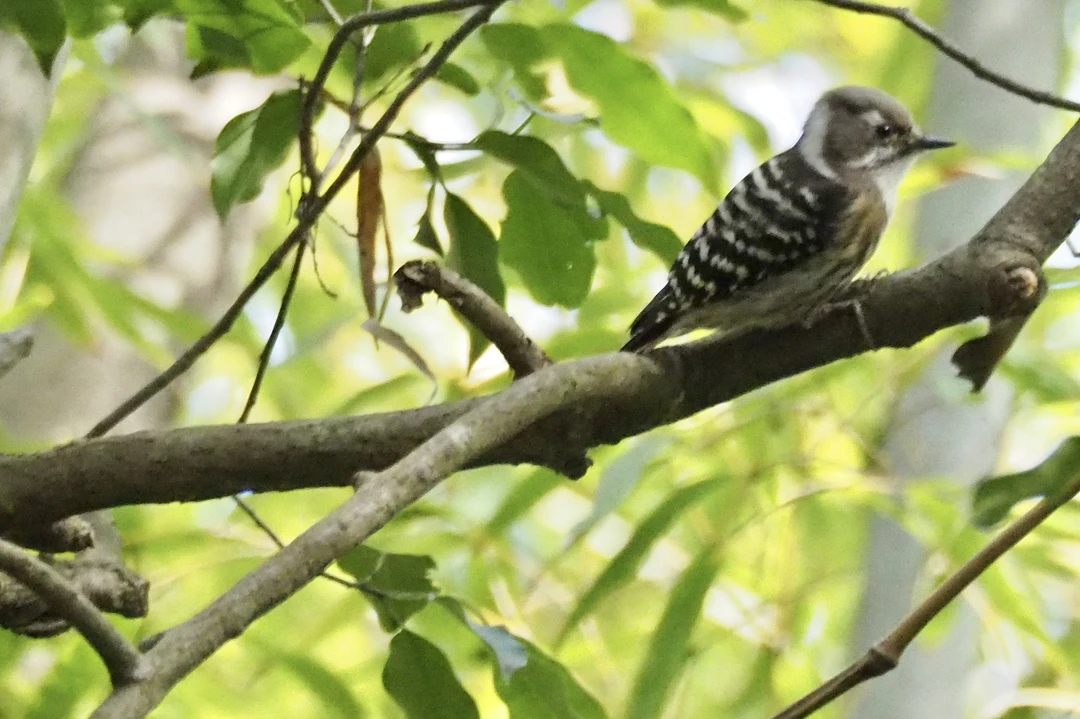
Compare plumage, posture, and field context across this image set.
About the Japanese Pygmy Woodpecker
The Japanese Pygmy Woodpecker (*Yungipicus kizuki*) is a small woodpecker species found in Japan, Korea, and parts of eastern Russia and northeastern China. It plays a crucial role in its forest ecosystem by controlling insect populations, and its presence is often an indicator of a healthy woodland environment. Unlike many woodpeckers, it doesn't excavate large cavities, preferring smaller holes in decaying wood. It is not particularly known for significant cultural importance, but it is a welcomed and familiar sight in Japanese woodlands and gardens.
Also known as: Pygmy Woodpecker.
Scientific classification
Phylum: Chordata
Clazz: Aves
Order: Piciformes
Family: Picidae
Genus: Dendrocopos
Species: Yungipicus kizuki
Habitat and distribution
Adaptations: Their small size allows them to forage on thin branches and twigs that larger woodpeckers cannot access. Their strong claws and stiff tail feathers provide excellent grip and support on vertical tree trunks. Their bill, while smaller than other woodpeckers, is still strong for pecking and extracting insects from under bark.
Variations: Several subspecies have been described, differing slightly in size, plumage coloration, and geographic location. For example, *Y. k. seebohmi* is found in Hokkaido and is slightly larger and darker than the nominate subspecies *Y. k. kizuki* found in Honshu.
Distribution: The Japanese Pygmy Woodpecker is primarily found in Japan (Hokkaido, Honshu, Shikoku, Kyushu, and surrounding islands), the Korean Peninsula, Sakhalin Island, the southern Kuril Islands, and parts of northeastern China and the Russian Far East (Ussuriland). It is generally non-migratory, though some populations may undertake short-distance altitudinal movements in winter.
Habitat Types: Temperate deciduous forests, Mixed forests, Coniferous forests, Subtropical evergreen forests, Urban parks and gardens (with sufficient tree cover)
Climate Zones: Temperate, Subtropical (in southern parts of its range)
Diet and feeding
Primary foods: Insects, Larvae, Spiders, Ants, Small invertebrates, Seeds, Berries
Foraging behavior: Forages by gleaning insects from the bark surface, probing into crevices, and tapping on wood to locate prey. It often moves along small branches and twigs, unlike larger woodpeckers that focus on tree trunks. It may also visit bird feeders, especially in winter.
Seasonal diet variations: Diet shifts slightly with the seasons. Insects and larvae are the primary food source during the breeding season, while seeds and berries may become more important in winter when insects are less available.
Specializations: Its small size and relatively short bill are adapted for foraging on thin branches and extracting insects from small crevices. It has a slightly barbed tongue, typical of woodpeckers, to help extract insects.
Reproduction and lifecycle
Breeding season: April-June
Regional variations: Slight variations depending on latitude and local climate, with breeding starting earlier in warmer regions.
Courtship rituals: Courtship involves drumming (rapid tapping on wood), calling, and chasing between males and females. Males may also display their red nape patch to attract females.
Nest Type: Cavity nest excavated in a decaying tree branch or trunk, often relatively low to the ground.
Nesting Materials: Wood chips (from excavation)
Parental care: Both parents share incubation duties (lasting about 11-13 days) and feeding of the chicks. Chicks are altricial (born helpless and requiring extensive parental care).
Fledging period: Approximately 18-21 days after hatching.
Clutch Size: 4-7 eggs
Physical characteristics
Sex-Based Plumage Differences: Minimal
Length: 13-15 cm
Wingspan: 20-25 cm
Weight: 17-25 g
Lifespan: Unknown, but likely similar to other small woodpeckers (around 4-7 years in the wild).
Breeding Plumage: Little to no difference between breeding and non-breeding plumage.
Seasonal Feather Changes: Minimal seasonal variation.
Notable features: Brownish-grey upperparts with white barring., White underparts with dark streaks., Black and white facial pattern., Small, pointed bill.
Interesting facts
The Japanese Pygmy Woodpecker is one of the smallest woodpecker species in the world.: Its small size allows it to exploit a niche that larger woodpeckers cannot.
It is sometimes called the 'Kogera' in Japanese.: 'Ko' means small, and 'gera' is derived from 'keratsutsuki,' the Japanese word for woodpecker.
Unlike many woodpeckers, it doesn't rely as heavily on drumming for communication.: While it does drum, its calls are more frequently used for communication.
They are known to be quite adaptable, inhabiting both natural forests and human-altered environments like parks and gardens.: This adaptability contributes to their relatively stable population.
Frequently asked questions
What do I do if I find a Japanese Pygmy Woodpecker nest?
Observe from a distance and avoid disturbing the nest. It is illegal to harm or disturb nesting birds in most areas.
Are Japanese Pygmy Woodpeckers harmful to trees?
No, they primarily feed on insects that live under the bark of trees, and they usually nest in already decaying wood. They play a beneficial role in controlling insect populations.
Can I attract Japanese Pygmy Woodpeckers to my garden?
Providing a source of food (such as suet or sunflower seeds) and water, and leaving some dead or decaying wood (if safe to do so), may attract them. Planting native trees and shrubs can also create a suitable habitat.
How can I tell the difference between a male and a female?
Males have a small red patch on the back of their head (nape), while females do not.
Compare the image, sound, habitat, and physical characteristics together when reviewing a sighting.