
The Hawfinch (*Coccothraustes coccothraustes*) is a striking and powerful finch, renowned for its massive bill capable of cracking open even the hardest of seeds and fruit stones. It plays a crucial ecological role in seed dispersal, particularly for trees with large, tough seeds that few other birds can manage. While not as widely recognized in popular culture as some other finches, the Hawfinch holds a quiet appeal for birdwatchers due to its elusive nature and distinctive appearance. It is a symbol of strength and resilience within its woodland habitats.
Photos of Hawfinch
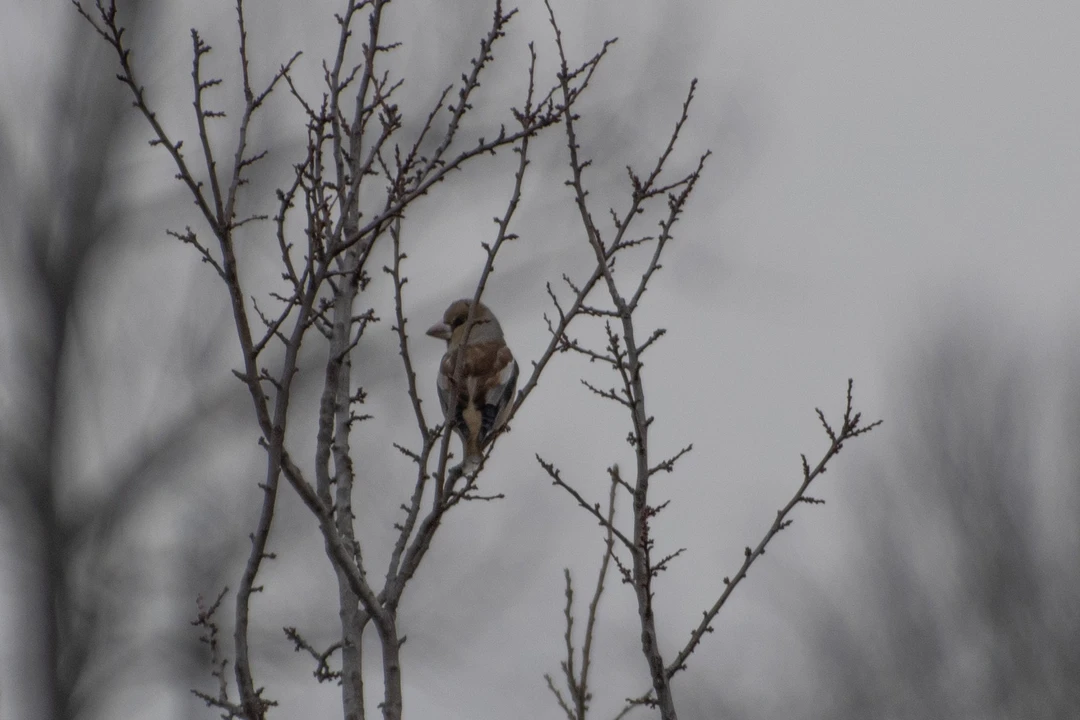
Compare plumage, posture, and field context across this image set.
Hawfinch sounds
Listen to a small selection of reference recordings.
About the Hawfinch
The Hawfinch (*Coccothraustes coccothraustes*) is a striking and powerful finch, renowned for its massive bill capable of cracking open even the hardest of seeds and fruit stones. It plays a crucial ecological role in seed dispersal, particularly for trees with large, tough seeds that few other birds can manage. While not as widely recognized in popular culture as some other finches, the Hawfinch holds a quiet appeal for birdwatchers due to its elusive nature and distinctive appearance. It is a symbol of strength and resilience within its woodland habitats.
Scientific classification
Phylum: Chordata
Clazz: Aves
Order: Passeriformes
Family: Fringillidae
Genus: Coccothraustes
Species: Coccothraustes coccothraustes
Habitat and distribution
Adaptations: The Hawfinch's primary adaptation is its extraordinarily powerful bill and associated jaw muscles, which allow it to access food sources unavailable to most other birds. They also have relatively short, strong legs for perching on branches while manipulating large seeds.
Variations: Several subspecies are recognized, differing slightly in size, bill shape, and plumage coloration. For example, *C. c. japonicus* is found in Japan, and *C. c. nigricans* is found in Southern Europe.
Distribution: The Hawfinch has a wide distribution across Europe and temperate Asia, extending eastwards to Japan. It is also found in parts of North Africa. Populations in northern and eastern Europe are partially migratory, moving south and west for the winter.
Habitat Types: Deciduous woodlands, Mixed forests, Orchards, Parks with mature trees, Large gardens
Climate Zones: Temperate, Boreal (in some areas)
Diet and feeding
Primary foods: Seeds, Fruit stones (e.g., cherries, olives), Berries, Insects (especially during breeding season)
Foraging behavior: Hawfinches forage both in trees and on the ground. They often perch on branches while cracking seeds with their powerful bills. They may also hop on the ground to pick up fallen seeds.
Seasonal diet variations: The diet shifts seasonally, with a greater reliance on insects during the breeding season to provide protein for growing chicks. In winter, they rely heavily on seeds and fruit stones.
Specializations: The Hawfinch's bill is its defining specialization. The jaw muscles are exceptionally strong, allowing it to generate a force sufficient to crack open very hard seeds and fruit stones, such as cherry and olive pits.
Reproduction and lifecycle
Breeding season: Typically April to June in Europe.
Regional variations: Breeding may start slightly earlier in southern parts of the range and later in northern regions.
Courtship rituals: Courtship involves the male displaying his plumage to the female, often with head-bobbing and wing-flicking. He may also offer food to the female.
Nest Type: A cup-shaped nest, usually built high in a tree or bush.
Nesting Materials: Twigs, Roots, Lichen, Moss, Animal hair
Parental care: Both parents incubate the eggs (for about 11-13 days) and feed the chicks. The female does most of the incubating.
Fledging period: Approximately 10-14 days until the chicks leave the nest.
Clutch Size: Typically 4-5 eggs.
Physical characteristics
Sex-Based Plumage Differences: Minimal
Length: 16.5-18 cm
Wingspan: 29-33 cm
Weight: 48-62 g
Lifespan: Typically 3-5 years in the wild, but can live longer.
Breeding Plumage: Breeding plumage is more vibrant, with males showing a richer brown back, a black bib, and a bright blue-grey band on the wings. Non-breeding plumage is duller, with less contrast.
Seasonal Feather Changes: The bill color changes seasonally. It is a blue-grey in the breeding season, turning to a horn color in the winter.
Notable features: Massive, conical bill, Thick neck, Black mask and bib (more prominent in males), White wing bars
Interesting facts
They can exert a force of up to 150 pounds per square inch with their bills.: This allows them to crack open incredibly tough seeds that are inaccessible to most other birds.
They are notoriously shy and difficult to observe.: Despite their bright plumage, they often remain hidden in the tree canopy.
Hawfinch flocks can strip a cherry tree clean.: Their attraction to these fruits makes them a minor pest in some orchards, although habitat loss has a greater impact.
Frequently asked questions
What is the best way to attract Hawfinches to my garden?
Planting trees that produce large seeds or fruits, such as cherry, hornbeam, or beech, may attract them. Providing a source of fresh water can also help.
Are Hawfinches aggressive?
They can be aggressive towards other birds at feeding sites, especially during the breeding season. However, they are generally shy and avoid human contact.
How can I tell the difference between a male and female Hawfinch?
Males have brighter plumage, a more defined black mask and bib, and a more intense blue-grey patch on the wings.
Where can I find Hawfinches?
Look for Hawfinches in mature deciduous or mixed woodlands, especially those with trees that produce large seeds or fruits. Parks and large gardens with mature trees can also be good places to spot them.
Compare the image, sound, habitat, and physical characteristics together when reviewing a sighting.