
The Grey Junglefowl (*Gallus sonneratii*) is a wild bird belonging to the pheasant family, primarily found in India. It plays a significant ecological role as a seed disperser and prey for larger predators. Unlike the Red Junglefowl, the ancestor of domestic chickens, the Grey Junglefowl has a more restricted range and distinct plumage. It holds cultural significance in India, sometimes appearing in local folklore and traditional practices. It is known for its unique calls and striking appearance, particularly the male's intricate neck hackles.
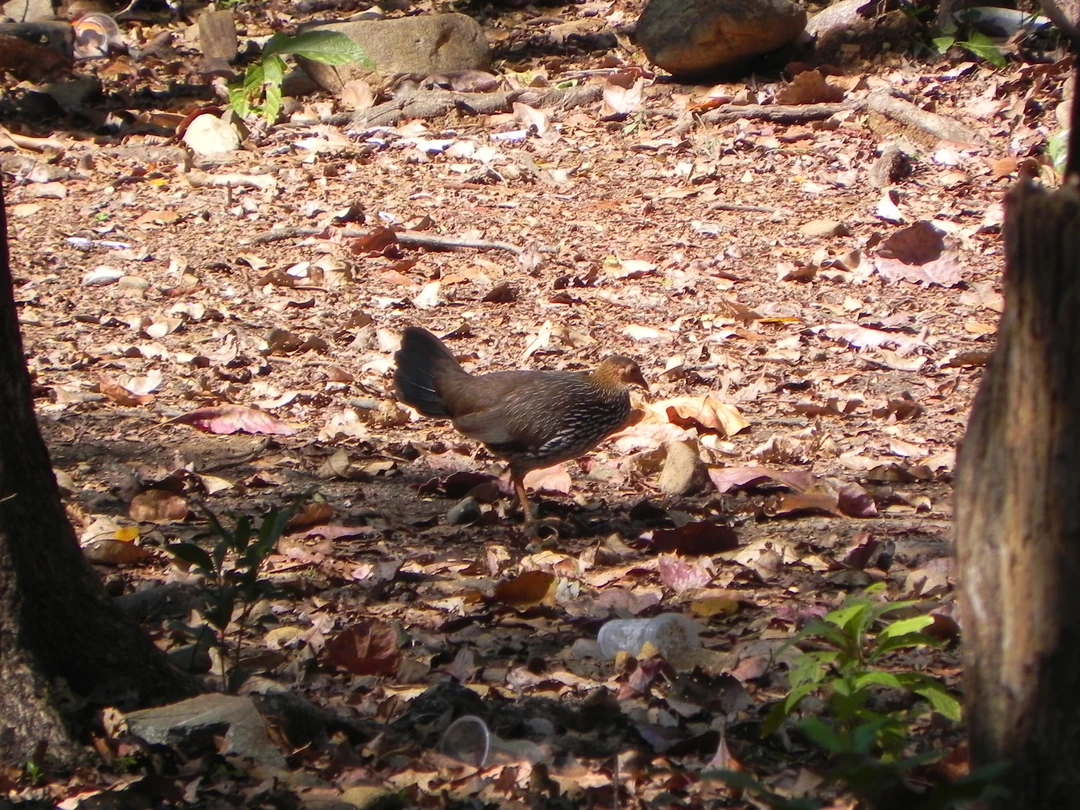
Photos of Grey Junglefowl
Compare plumage, posture, and field context across this image set.
About the Grey Junglefowl
The Grey Junglefowl (*Gallus sonneratii*) is a wild bird belonging to the pheasant family, primarily found in India. It plays a significant ecological role as a seed disperser and prey for larger predators. Unlike the Red Junglefowl, the ancestor of domestic chickens, the Grey Junglefowl has a more restricted range and distinct plumage. It holds cultural significance in India, sometimes appearing in local folklore and traditional practices. It is known for its unique calls and striking appearance, particularly the male's intricate neck hackles.
Also known as: Gray Junglefowl.
Scientific classification
Phylum: Chordata
Clazz: Aves
Order: Galliformes
Family: Phasianidae
Genus: Gallus
Species: Gallus sonneratii
Habitat and distribution
Adaptations: The Grey Junglefowl's cryptic plumage provides camouflage within its forested habitat. Its strong legs and feet are well-suited for scratching and foraging on the forest floor. They are also capable of short bursts of flight to escape predators.
Variations: While no formally recognized subspecies exist, slight variations in plumage and size may be observed across its range.
Distribution: Primarily found in peninsular India. Its range extends from the southern edge of the Himalayas southwards, excluding the northeastern states and parts of the eastern coast. It is particularly common in the Western Ghats and central Indian forests.
Habitat Types: Dry deciduous forests, Moist deciduous forests, Scrub jungles, Bamboo thickets, Secondary forests
Climate Zones: Tropical, Subtropical
Diet and feeding
Primary foods: Seeds, Grains, Insects, Berries, Small reptiles, Plant shoots
Foraging behavior: The Grey Junglefowl primarily forages on the ground by scratching and pecking at the leaf litter. They often forage in small groups, particularly during the non-breeding season.
Seasonal diet variations: Diet varies seasonally depending on food availability. Insects may be more prevalent in the diet during the monsoon season, while seeds and grains dominate during drier periods.
Specializations: Their strong legs and feet are adapted for scratching and uncovering food items on the forest floor.
Reproduction and lifecycle
Breeding season: Primarily from February to May, though it can vary slightly depending on the region and local rainfall patterns.
Regional variations: Breeding may be slightly earlier in southern India compared to northern parts of its range.
Courtship rituals: Males perform elaborate courtship displays, including lowering their wings, spreading their tails, and displaying their ornate neck hackles. They also use vocalizations to attract females.
Nest Type: A simple scrape on the ground, often concealed under dense vegetation or at the base of a tree or bush.
Nesting Materials: Leaves, Twigs, Grass
Parental care: The female incubates the eggs for approximately 21 days. The male does not participate in incubation but may remain nearby to guard the territory. Chicks are precocial and can leave the nest shortly after hatching. The female provides care and protection for the chicks.
Fledging period: Chicks can make short flights within a few weeks, but they remain with the female for several months.
Clutch Size: Typically 4-6 eggs.
Physical characteristics
Sex-Based Plumage Differences: Yes, significant difference
Length: Male: 70-80 cm, Female: 38-42 cm
Wingspan: 65-75 cm
Weight: Male: 790-1136 g, Female: 705-790 g
Lifespan: Unknown in the wild, likely 5-8 years, potentially longer in captivity.
Breeding Plumage: Males have distinct breeding plumage characterized by elongated, glossy neck hackles with unique black and white patterns. Non-breeding males may have slightly duller plumage.
Seasonal Feather Changes: Males molt after the breeding season, losing their elongated hackles. The eclipse plumage is less ornate.
Notable features: Unique 'ocellate' neck hackles in males, Comb and wattles (smaller in females), Strong legs and feet for ground foraging, Sharp spurs on the legs of males, used in dominance displays and fighting
Interesting facts
The Grey Junglefowl's neck hackles are used in fly-tying: The unique feathers are sought after for creating artificial fishing lures.
It is one of the four species of junglefowl: The others being the Red Junglefowl, Green Junglefowl, and Sri Lankan Junglefowl.
They can hybridize with domestic chickens.: Although less common than Red Junglefowl hybridization, it can occur where ranges overlap.
Frequently asked questions
What is the difference between Grey Junglefowl and Red Junglefowl?
Grey Junglefowl are found primarily in peninsular India, while Red Junglefowl have a wider distribution across South and Southeast Asia. Males have distinct plumage differences; Grey Junglefowl males possess unique 'ocellate' neck hackles, which Red Junglefowl males lack.
Are Grey Junglefowl related to domestic chickens?
Yes, both are members of the Phasianidae family. The Red Junglefowl is considered the primary ancestor of domestic chickens, but Grey Junglefowl may have contributed some genes through hybridization.
Are Grey Junglefowl endangered?
No, they are currently classified as 'Least Concern' by the IUCN. However, habitat loss and hunting continue to pose threats.
What do Grey Junglefowl eat?
Their diet is omnivorous and includes seeds, grains, insects, berries, and small reptiles.
Compare the image, sound, habitat, and physical characteristics together when reviewing a sighting.