
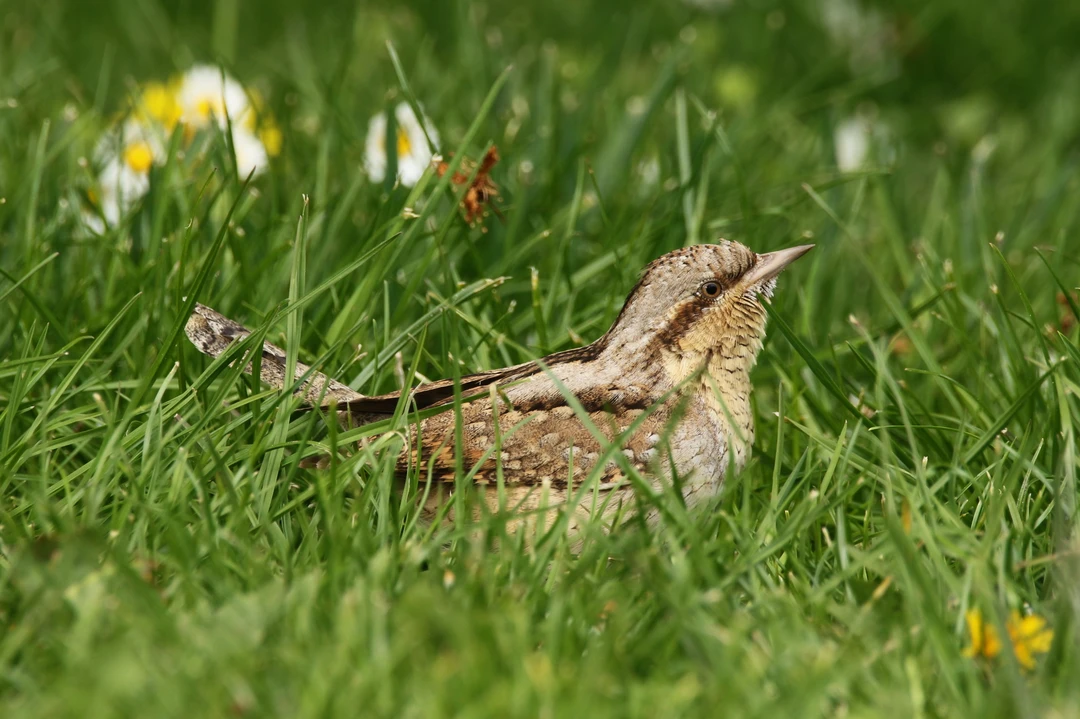
The Eurasian Wryneck (*Jynx torquilla*) is a unique species of woodpecker known for its cryptic plumage and snake-like neck twisting behavior, which gives it its common name. Unlike most woodpeckers, it doesn't excavate tree cavities but instead utilizes pre-existing holes. It plays a crucial role in controlling insect populations, particularly ants, which form the bulk of its diet. The wryneck holds a place in folklore and mythology, often associated with witchcraft and divination due to its unusual head movements.
Photos of Eurasian Wryneck
Compare plumage, posture, and field context across this image set.
About the Eurasian Wryneck
The Eurasian Wryneck (*Jynx torquilla*) is a unique species of woodpecker known for its cryptic plumage and snake-like neck twisting behavior, which gives it its common name. Unlike most woodpeckers, it doesn't excavate tree cavities but instead utilizes pre-existing holes. It plays a crucial role in controlling insect populations, particularly ants, which form the bulk of its diet. The wryneck holds a place in folklore and mythology, often associated with witchcraft and divination due to its unusual head movements.
Also known as: Northern Wryneck.
Scientific classification
Phylum: Chordata
Clazz: Aves
Order: Piciformes
Family: Picidae
Genus: Jynx
Species: Jynx torquilla
Habitat and distribution
Adaptations: Their preference for open woodlands and areas with sparse tree cover allows for easier foraging on the ground. Their cryptic plumage provides camouflage against predators while they search for ants and other insects.
Variations: Several subspecies are recognized, differing slightly in plumage coloration and size, reflecting adaptations to local environments across their vast range.
Distribution: The Eurasian Wryneck has a broad distribution, breeding across Europe and temperate Asia, extending from the British Isles and the Iberian Peninsula eastward to Japan. It is a long-distance migrant, wintering in sub-Saharan Africa and tropical Asia, including the Indian subcontinent and Southeast Asia.
Habitat Types: Open Woodlands, Orchards, Parks, Hedgerows, Farmland with scattered trees
Climate Zones: Temperate, Boreal, Mediterranean
Diet and feeding
Primary foods: Ants, Ant larvae and pupae, Other insects (occasionally)
Foraging behavior: The Eurasian Wryneck primarily forages on the ground, using its long, sticky tongue to extract ants and their brood from nests in the soil or under bark. It may also glean insects from tree trunks and branches, but less frequently than other woodpeckers.
Seasonal diet variations: Diet remains largely consistent throughout the year, focused on ants. However, during the breeding season, they may consume a slightly wider variety of insects to provide additional protein for their chicks.
Specializations: Its tongue is exceptionally long and covered in sticky saliva, with a barbed tip, perfectly adapted for extracting ants from their nests. It lacks the strong, chisel-like bill of typical woodpeckers, reflecting its different feeding strategy.
Reproduction and lifecycle
Breeding season: Typically May-June in Europe, with slight variations depending on latitude and local climate.
Regional variations: Breeding may start earlier in southern parts of its range and later in the north.
Courtship rituals: Courtship involves calling, head-bobbing, and neck-twisting displays. Males may also offer food to females.
Nest Type: Uses pre-existing cavities, such as old woodpecker holes, tree hollows, or nest boxes. They do not excavate their own nests.
Nesting Materials: Little to no nesting material is added., May use existing wood chips or debris.
Parental care: Both parents share incubation duties, which last for about 12-14 days. Both parents also feed the chicks, regurgitating insects.
Fledging period: Approximately 19-21 days until the young birds leave the nest.
Clutch Size: 7-10 eggs, sometimes up to 12.
Physical characteristics
Sex-Based Plumage Differences: Minimal
Length: 16-18 cm
Wingspan: 25-30 cm
Weight: 26-50 g
Lifespan: Up to 10 years in the wild, although average lifespan is likely shorter.
Breeding Plumage: Plumage is relatively consistent throughout the year, with subtle variations. The intricate patterns provide excellent camouflage.
Seasonal Feather Changes: Minor; molting occurs after breeding, but overall appearance remains similar.
Notable features: Cryptic, mottled brown, grey, and black plumage for camouflage., Long, flexible neck capable of snake-like movements., Sharp, pointed bill for probing for insects., Zygodactyl feet (two toes pointing forward, two backward), typical of woodpeckers, although less specialized for climbing than other species.
Interesting facts
The Wryneck's name comes from its ability to twist its head almost 180 degrees.: This snake-like movement, combined with hissing, is a defense mechanism used to deter predators from approaching the nest.
Unlike most woodpeckers, wrynecks do not drum on trees.: They lack the specialized skull and neck musculature required for forceful drumming.
Wrynecks are sometimes called 'cuckoo's mates' in some regions.: This is because their arrival in spring often coincides with the arrival of cuckoos.
Frequently asked questions
Why don't wrynecks make their own nest holes?
They lack the strong, chisel-like bill and powerful neck muscles that other woodpeckers use to excavate cavities. They rely on finding pre-existing holes.
What eats a Eurasian Wryneck?
Predators include birds of prey (such as sparrowhawks), weasels, and snakes, particularly when nesting or roosting.
Are Eurasian Wrynecks rare?
While classified as Least Concern globally, they have declined significantly in some regions, making them locally rare or uncommon. Habitat loss is a major factor.
Compare the image, sound, habitat, and physical characteristics together when reviewing a sighting.