
The Eurasian Wren ( *Troglodytes troglodytes*) is a tiny, energetic songbird found across Eurasia and parts of North Africa. Despite its small size, it possesses a remarkably loud and complex song, often surprising those unfamiliar with it. This wren plays a vital role in controlling insect populations within its diverse habitats. In some cultures, the wren is associated with folklore and symbolism, often representing agility, quick wit, and the coming of spring.
Photos of Eurasian Wren
Compare plumage, posture, and field context across this image set.
About the Eurasian Wren
The Eurasian Wren ( *Troglodytes troglodytes*) is a tiny, energetic songbird found across Eurasia and parts of North Africa. Despite its small size, it possesses a remarkably loud and complex song, often surprising those unfamiliar with it. This wren plays a vital role in controlling insect populations within its diverse habitats. In some cultures, the wren is associated with folklore and symbolism, often representing agility, quick wit, and the coming of spring.
Also known as: Northern Wren, Jenny Wren.
Scientific classification
Phylum: Chordata
Clazz: Aves
Order: Passeriformes
Family: Troglodytidae
Genus: Troglodytes
Species: Troglodytes troglodytes
Habitat and distribution
Adaptations: Its small size and rounded wings allow it to maneuver through dense undergrowth. Strong legs and feet enable it to cling to branches and creep along crevices in search of food.
Variations: Numerous subspecies (over 20) are recognized, differing slightly in plumage coloration and size. Island populations, such as those in the British Isles and Iceland, often exhibit distinct characteristics.
Distribution: The Eurasian Wren has a vast range, extending across Europe, Asia (including Japan and the Himalayas), and North Africa. It is largely resident, though northern populations may migrate short distances south in winter. Altitudinally, it can be found from sea level up to the treeline in mountainous regions.
Habitat Types: Deciduous woodlands, Coniferous forests, Mixed woodlands, Hedgerows, Gardens, Parks, Scrubland, Heathland
Climate Zones: Temperate, Boreal, Mediterranean
Diet and feeding
Primary foods: Insects, Spiders, Larvae, Beetles, Other small invertebrates
Foraging behavior: The Eurasian Wren forages actively in dense vegetation, creeping along branches, probing crevices, and searching under leaves and bark for prey. It often flicks its wings and tail while foraging.
Seasonal diet variations: While primarily insectivorous, it may consume some small seeds and berries during winter when insects are scarce.
Specializations: Its slender bill is well-suited for picking small insects and spiders from tight spaces.
Reproduction and lifecycle
Breeding season: Typically from April to July in temperate regions.
Regional variations: Breeding season may start earlier in milder climates and later in colder regions.
Courtship rituals: Males build multiple dome-shaped nests to attract females. Courtship involves singing, displaying the nest, and offering food to the female.
Nest Type: Dome-shaped nest with a side entrance.
Nesting Materials: Moss, Leaves, Twigs, Feathers, Hair
Parental care: The female incubates the eggs for 14-17 days. Both parents feed the chicks, which fledge after about 15-20 days.
Fledging period: 15-20 days
Clutch Size: Typically 5-8 eggs.
Physical characteristics
Sex-Based Plumage Differences: Minimal
Length: 8-11 cm
Wingspan: 13-17 cm
Weight: 6-12 g
Lifespan: Typically 2-3 years in the wild, although some individuals can live up to 7 years.
Breeding Plumage: Plumage is generally similar year-round.
Seasonal Feather Changes: Minimal seasonal variation.
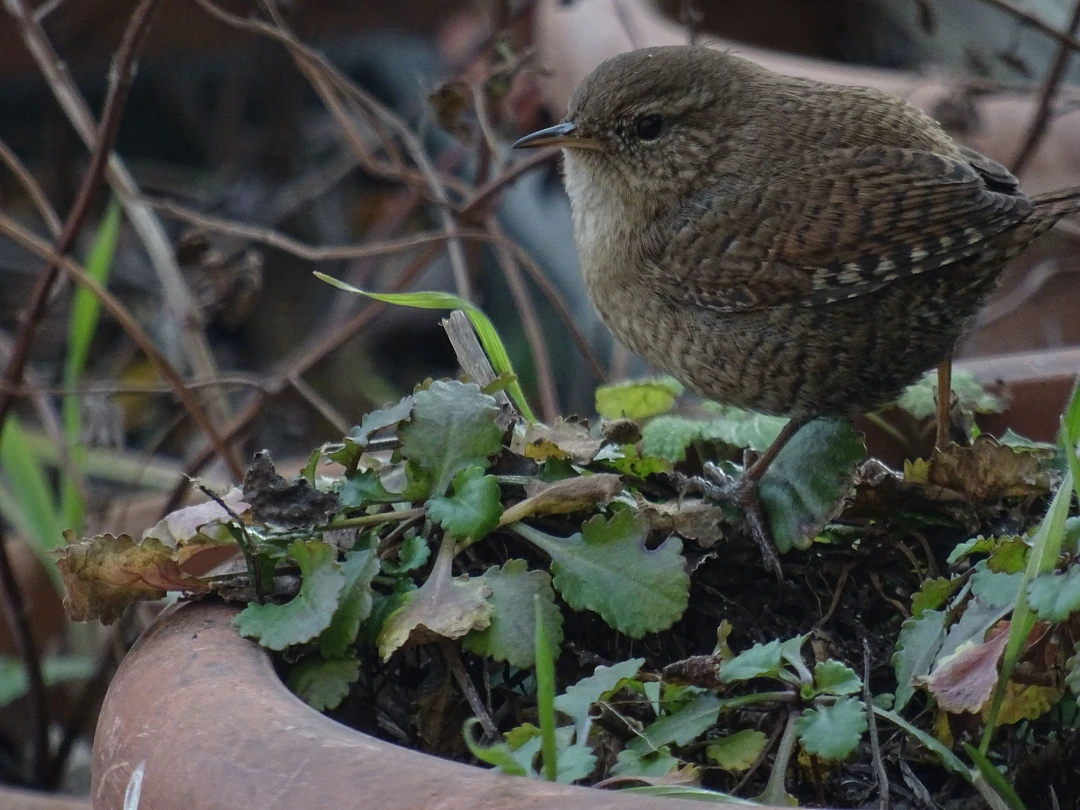
Notable features: Small, rounded body shape, Short, often cocked tail, Rich brown upperparts with darker barring, Pale buffish-brown underparts, Prominent pale eyebrow stripe
Interesting facts
The Eurasian Wren has one of the loudest songs for its size of any bird.: Its powerful song is used to establish territory and attract mates.
The male wren builds several nests, but only one is chosen by the female.: This behavior may be a way for the female to assess the male's quality.
The scientific name, *Troglodytes troglodytes*, means 'cave dweller'.: This refers to its habit of nesting in crevices and holes.
Frequently asked questions
What do I do if I find a baby wren?
If the bird appears healthy and is fully feathered, it is likely a fledgling and its parents are probably nearby. It is best to leave it alone. If it is injured or obviously orphaned, contact a local wildlife rehabilitator. Consult a professional for medical or expert advice.
How can I attract wrens to my garden?
Provide dense, low-growing vegetation, such as shrubs and hedges. Leave leaf litter and avoid using pesticides. A source of fresh water can also be attractive.
Are Eurasian Wrens aggressive?
Males are territorial during the breeding season and will defend their territory against other wrens. However, they are not typically aggressive towards humans.
Compare the image, sound, habitat, and physical characteristics together when reviewing a sighting.