
The Eurasian Bullfinch (*Pyrrhula pyrrhula*) is a small, plump passerine bird known for its distinctive rosy-red breast and cheeks in males, contrasting with a black cap and grey back. Females and juveniles exhibit a more subdued buff-brown coloration. This species plays a significant role in seed dispersal within its woodland and orchard habitats. While generally not considered a bird of significant cultural importance like some other finches, it is often featured in European folklore and art, sometimes symbolizing winter or resilience due to its ability to thrive in colder climates. Its shy nature and preference for dense cover make it a rewarding, though sometimes challenging, bird to observe.
Photos of Eurasian Bullfinch
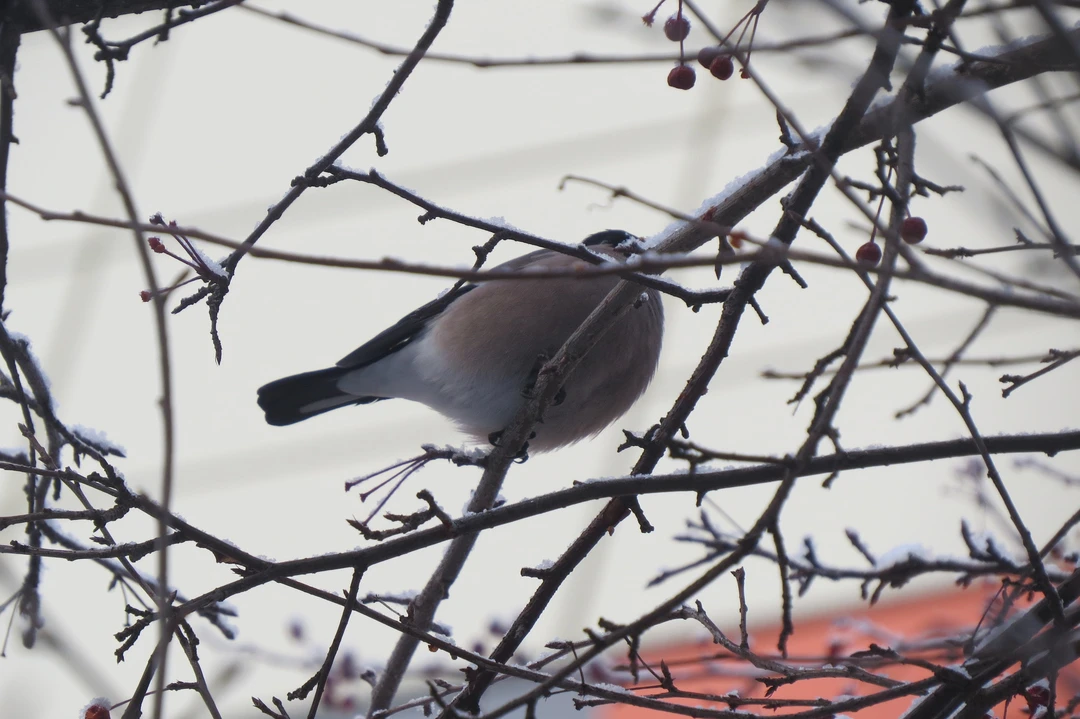
Compare plumage, posture, and field context across this image set.
About the Eurasian Bullfinch
The Eurasian Bullfinch (*Pyrrhula pyrrhula*) is a small, plump passerine bird known for its distinctive rosy-red breast and cheeks in males, contrasting with a black cap and grey back. Females and juveniles exhibit a more subdued buff-brown coloration. This species plays a significant role in seed dispersal within its woodland and orchard habitats. While generally not considered a bird of significant cultural importance like some other finches, it is often featured in European folklore and art, sometimes symbolizing winter or resilience due to its ability to thrive in colder climates. Its shy nature and preference for dense cover make it a rewarding, though sometimes challenging, bird to observe.
Also known as: Common Bullfinch, Northern Bullfinch.
Scientific classification
Phylum: Chordata
Clazz: Aves
Order: Passeriformes
Family: Fringillidae
Genus: Pyrrhula
Species: Pyrrhula pyrrhula
Habitat and distribution
Adaptations: The Bullfinch's robust bill is well-adapted for cracking seeds and buds, a crucial adaptation for surviving in areas with seasonal food availability. Their relatively sedentary nature, except in the harshest climates, allows them to conserve energy during winter months.
Variations: Several subspecies of *Pyrrhula pyrrhula* are recognized, differing slightly in size, plumage coloration, and bill morphology. These variations are often linked to geographic isolation and adaptation to local food sources. For example, some island populations may exhibit darker plumage.
Distribution: The Eurasian Bullfinch has a wide distribution across Europe and Asia, extending from the British Isles and Iberia eastward across Russia to Japan. It is found in both temperate and boreal regions. Migratory patterns vary; northern populations tend to be more migratory, moving south for the winter, while southern populations are often resident.
Habitat Types: Coniferous forests, Mixed woodlands, Hedgerows, Orchards, Parks and gardens (with sufficient cover)
Climate Zones: Temperate, Boreal
Diet and feeding
Primary foods: Seeds, Buds (especially of fruit trees), Berries, Insects (primarily during breeding season)
Foraging behavior: Bullfinches typically forage in trees and shrubs, often in small flocks, especially outside the breeding season. They are adept at clinging to branches and extracting seeds from buds and cones. They may also forage on the ground for fallen seeds.
Seasonal diet variations: Their diet shifts seasonally. In spring and summer, they consume more insects and buds, providing protein for breeding and growing chicks. In autumn and winter, they rely heavily on seeds and berries.
Specializations: Their strong, conical bill is perfectly adapted for cracking open seeds and buds. This allows them to access food sources that are unavailable to birds with weaker bills.
Reproduction and lifecycle
Breeding season: Generally from late April to July, though this can vary slightly depending on latitude and local climate.
Regional variations: Breeding may start slightly earlier in warmer, southern regions and later in colder, northern areas.
Courtship rituals: Courtship involves the male displaying his bright plumage to the female, often accompanied by soft calls and bowing movements. He may also offer the female food as part of the courtship display.
Nest Type: A cup-shaped nest, typically built low down in dense bushes or trees.
Nesting Materials: Twigs, Moss, Lichens, Lined with fine roots and hair
Parental care: Both parents share incubation duties, which last for about 12-14 days. Both parents also feed the chicks, initially with insects and later with regurgitated seeds.
Fledging period: The chicks fledge (leave the nest) after approximately 12-18 days.
Clutch Size: Usually 4-5 eggs.
Physical characteristics
Sex-Based Plumage Differences: Minimal
Length: 14.5-16 cm
Wingspan: 22-29 cm
Weight: 21-27 g
Lifespan: Typically 2-3 years in the wild, but can live longer in captivity (up to 17 years recorded).
Breeding Plumage: Adult males have a bright rosy-red breast, cheeks, and belly, a black cap and face, a grey back, and white rump. Females and juveniles have a buff-brown breast and underparts, retaining the black cap and grey back, but lacking the bright red coloration. There's little seasonal variation beyond a slight dulling of the male's red outside the breeding season.
Seasonal Feather Changes: Minor. Colors may be slightly brighter during breeding season.
Notable features: Black cap extending to below the eye, Thick, stubby black bill, White rump, conspicuous in flight, Black wings with a single, prominent white wing bar
Interesting facts
Bullfinches are known for their ability to mimic sounds.: Although not as accomplished mimics as some other birds, they can learn and repeat simple melodies.
They have a reputation for damaging fruit tree buds.: While they do eat buds, the extent of the damage is often overstated, and they also consume weed seeds, providing a beneficial service.
The Bullfinches found in the Azores ( *Pyrrhula murina*) were once considered a subspecies of the Eurasian Bullfinch, but are now listed as a separate species.: The Azores Bullfinch is critically endangered.
The name "bullfinch" refers to the bird's thick neck and robust build, resembling that of a bull.: This physical characteristic is reflected in the bird's common name.
Frequently asked questions
What is the difference between a male and female Bullfinch?
Male Bullfinches have a bright rosy-red breast and cheeks, while females are a duller buff-brown color.
Are Bullfinches rare?
No, Bullfinches are not rare across their range, although they can be locally uncommon due to habitat loss or other factors. They are classified as Least Concern by the IUCN.
Do Bullfinches migrate?
Northern populations of Eurasian Bullfinches are migratory, while southern populations are generally resident.
What do Bullfinches eat?
Bullfinches primarily eat seeds, buds, berries, and insects (especially during the breeding season).
Where do Bullfinches nest?
Bullfinches build cup-shaped nests in dense bushes or trees, typically low to the ground.
Compare the image, sound, habitat, and physical characteristics together when reviewing a sighting.