
The Cooper's Hawk (Accipiter cooperii) is a medium-sized hawk native to North America, renowned for its agility and hunting prowess in wooded habitats. It plays a crucial role in the ecosystem as a predator of small birds and mammals, helping to regulate their populations. It is a member of the Accipitridae family, which includes hawks, eagles, and kites. While not holding significant cultural importance compared to some raptors, its recovery from population declines in the mid-20th century is a conservation success story.
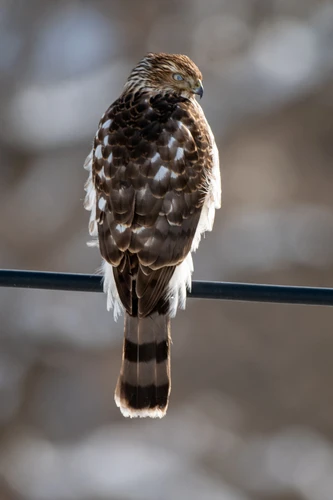
Photos of Cooper's Hawk
Compare plumage, posture, and field context across this image set.
Cooper's Hawk sounds
Listen to a small selection of reference recordings.
About the Cooper's Hawk
The Cooper's Hawk (Accipiter cooperii) is a medium-sized hawk native to North America, renowned for its agility and hunting prowess in wooded habitats. It plays a crucial role in the ecosystem as a predator of small birds and mammals, helping to regulate their populations. It is a member of the Accipitridae family, which includes hawks, eagles, and kites. While not holding significant cultural importance compared to some raptors, its recovery from population declines in the mid-20th century is a conservation success story.
Scientific classification
Phylum: Chordata
Clazz: Aves
Order: Accipitriformes
Family: Accipitridae
Genus: Accipiter
Species: Accipiter cooperii
Habitat and distribution
Adaptations: Their short, rounded wings and long tail provide exceptional maneuverability for navigating dense vegetation while pursuing prey.
Variations: While subtle, some regional variations in size and plumage coloration exist, though no formally recognized subspecies are widely accepted.
Distribution: Cooper's Hawks are found throughout North America, from southern Canada to northern Mexico. They breed across much of the United States and southern Canada. During winter, northern populations migrate south, some reaching as far as Central America. They have a broad altitudinal range, occurring from sea level to mountainous regions.
Habitat Types: Deciduous forests, Mixed woodlands, Riparian woodlands, Open woodlands with scattered trees, Suburban and urban areas with sufficient tree cover
Climate Zones: Temperate, Subtropical
Diet and feeding
Primary foods: Small birds (e.g., robins, starlings, doves), Small mammals (e.g., chipmunks, mice, squirrels), Occasionally reptiles and amphibians
Foraging behavior: Cooper's Hawks are skilled aerial hunters, often using a combination of stealth and speed. They may perch and wait for prey or fly low through vegetation, using surprise attacks. They are also known to pursue prey on foot.
Seasonal diet variations: Diet may shift slightly depending on prey availability. For example, they may take more mammals during winter when some bird species have migrated.
Specializations: Their agility and speed are key specializations, allowing them to capture fast-moving prey in cluttered environments.
Reproduction and lifecycle
Breeding season: Primarily March-June, but can vary slightly depending on latitude.
Regional variations: Southern populations may begin breeding earlier than northern populations.
Courtship rituals: Courtship involves aerial displays, including dives and chases, often accompanied by vocalizations. The male may also present food to the female.
Nest Type: Platform nest built of sticks, usually high in a tree.
Nesting Materials: Twigs, Sticks, Bark, Greenery (for lining)
Parental care: Both parents share incubation duties, which last about 30-36 days. The female primarily broods the young, while the male provides food. Both parents feed the chicks after hatching.
Fledging period: Approximately 27-34 days until the young hawks fledge (leave the nest).
Clutch Size: Typically 3-5 eggs.
Physical characteristics
Sex-Based Plumage Differences: Females are significantly larger than males.
Length: 35-50 cm
Wingspan: 62-94 cm
Weight: 220-680 g
Lifespan: Up to 12 years in the wild; longer in captivity (though data is limited).
Breeding Plumage: Adult plumage is similar year-round.
Seasonal Feather Changes: No significant seasonal variations, although plumage may appear more worn in late summer.
Notable features: Long, rudder-like tail with dark bands., Short, rounded wings., Red eyes in adults (yellow in juveniles)., Sharp, hooked beak for tearing prey.
Interesting facts
They are named after the naturalist William Cooper.: William Cooper was one of the founders of the New York Lyceum of Natural History (now the New York Academy of Sciences).
They are sometimes called "chicken hawks," although they rarely prey on chickens.: This misnomer likely arose from their occasional predation on small poultry, but their primary diet consists of wild birds and mammals.
Cooper's Hawks can catch birds in mid-flight.: Their exceptional agility and speed make them highly effective aerial predators.
Females are larger than males, a common trait in raptors.: Called 'reverse sexual dimorphism', it is thought to be due to several factors such as allowing them to incubate large clutches and subdue larger prey
Frequently asked questions
What should I do if I find an injured Cooper's Hawk?
Contact a local wildlife rehabilitator or veterinarian. Do not attempt to handle the bird yourself, as they have sharp talons and beaks. *Consult a professional for expert advice.*
Are Cooper's Hawks dangerous to humans?
No, Cooper's Hawks are not typically aggressive towards humans unless their nest is threatened. It is best to observe them from a distance.
How can I attract Cooper's Hawks to my backyard?
While you may not want to attract them directly (as they prey on songbirds), providing a natural habitat with trees and shrubs can make your yard more appealing to a variety of bird species, including Cooper's Hawks.
Do Cooper's Hawks mate for life?
Cooper's Hawks are thought to be mostly monogamous, often pairing with the same mate for several years. However, 'divorce' can occur, and they may find a new mate if their previous partner dies.
Compare the image, sound, habitat, and physical characteristics together when reviewing a sighting.