
The Common Raven (Corvus corax) is a large, all-black passerine bird found across the Northern Hemisphere. Renowned for its intelligence, the raven plays a significant role in the mythology and folklore of many cultures, often associated with both wisdom and trickery. Ecologically, it is a highly adaptable species, occupying diverse habitats and exhibiting a wide range of behaviors. It's an opportunistic omnivore, contributing to ecosystem health through scavenging and seed dispersal.
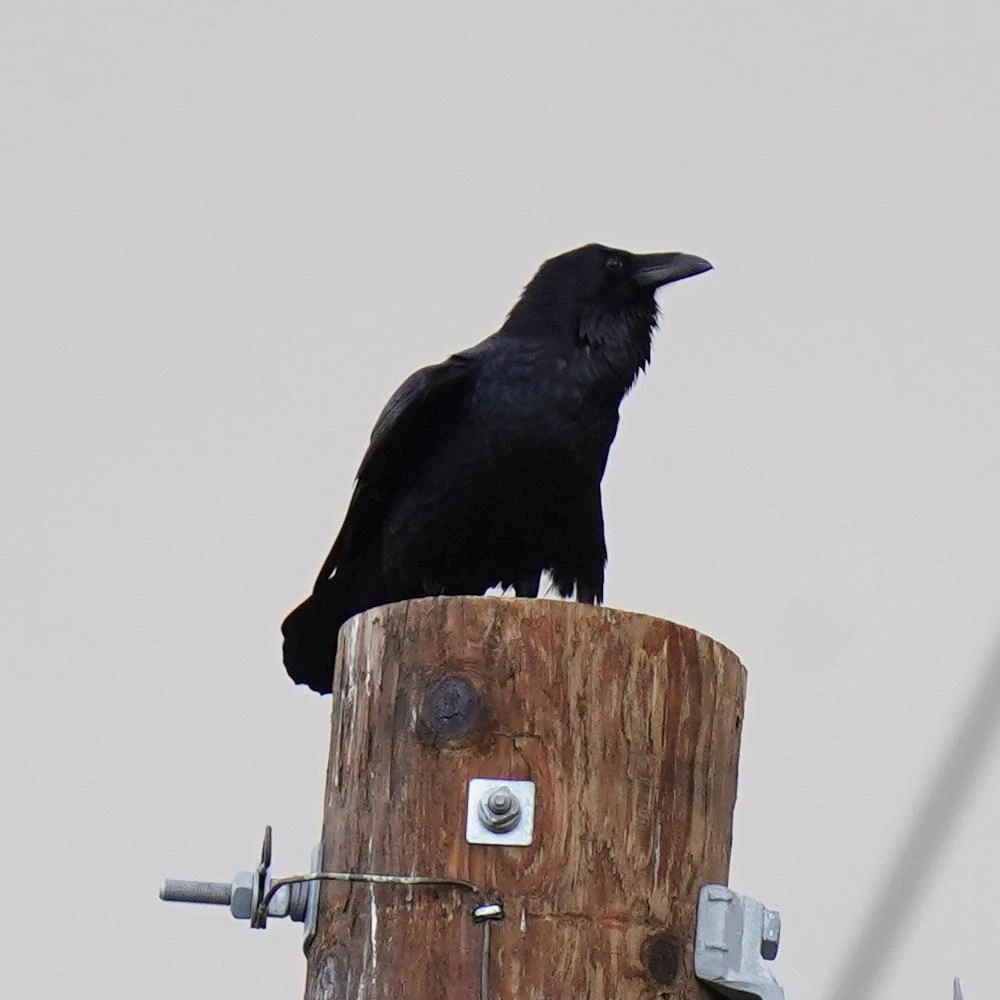
Photos of Common Raven
Compare plumage, posture, and field context across this image set.
Common Raven sounds
Listen to a small selection of reference recordings.
About the Common Raven
The Common Raven (Corvus corax) is a large, all-black passerine bird found across the Northern Hemisphere. Renowned for its intelligence, the raven plays a significant role in the mythology and folklore of many cultures, often associated with both wisdom and trickery. Ecologically, it is a highly adaptable species, occupying diverse habitats and exhibiting a wide range of behaviors. It's an opportunistic omnivore, contributing to ecosystem health through scavenging and seed dispersal.
Also known as: Raven, Northern Raven, Corby, Corbie.
Scientific classification
Phylum: Chordata
Clazz: Aves
Order: Passeriformes
Family: Corvidae
Genus: Corvus
Species: Corvus corax
Habitat and distribution
Adaptations: Highly adaptable to varied climates and food sources. Feathers provide excellent insulation in cold environments. Strong beaks and feet allow for manipulation of diverse food items.
Variations: Several subspecies are recognized, differing slightly in size and bill shape based on geographic location. For example, *Corvus corax principalis* in northern North America is larger than *Corvus corax sinuatus* in the southwestern United States and Mexico.
Distribution: Found across North America, Europe, Asia, and North Africa. Ranges from Arctic tundra to deserts and mountainous regions. Generally non-migratory, though some populations may move short distances in response to food availability.
Habitat Types: Tundra, Forests, Grasslands, Coastal cliffs, Deserts, Mountains, Urban areas
Climate Zones: Arctic, Temperate, Subtropical, Tropical
Diet and feeding
Primary foods: Carrion, Insects, Small mammals, Birds' eggs and nestlings, Fruits, Grains, Human refuse
Foraging behavior: Highly opportunistic; forages on the ground, in trees, or along shorelines. Known to cache food for later retrieval, displaying remarkable spatial memory.
Seasonal diet variations: Diet shifts based on food availability. May rely more on carrion in winter, insects in spring, and fruits in autumn.
Specializations: Strong bill allows for tearing flesh and manipulating objects. Highly adaptable to different food sources.
Reproduction and lifecycle
Breeding season: Typically late winter to early spring (February-May), depending on location.
Regional variations: Breeding may occur earlier in warmer climates and later in colder regions.
Courtship rituals: Includes aerial displays, mutual preening, and vocalizations. Pairs often mate for life.
Nest Type: Large stick nest, usually built on cliffs, in tall trees, or on human-made structures.
Nesting Materials: Sticks, Twigs, Bark, Animal hair, Moss
Parental care: Both parents incubate the eggs (18-21 days) and feed the chicks. Young ravens are altricial, meaning they are born helpless and require extensive parental care.
Fledging period: Approximately 4-7 weeks until first flight.
Clutch Size: Typically 3-7 eggs.
Physical characteristics
Sex-Based Plumage Differences: Males are generally slightly larger
Length: 56-78 cm
Wingspan: 115-150 cm
Weight: 689-2000 g
Lifespan: Up to 13 years in the wild; over 40 years in captivity.
Breeding Plumage: Plumage is generally glossy black year-round.
Seasonal Feather Changes: No significant seasonal variation, though feathers may appear duller when worn.
Notable features: Large, heavy bill, Shaggy throat feathers (hackles), Long, wedge-shaped tail, Strong legs and feet
Interesting facts
Ravens are among the most intelligent birds.: They are capable of problem-solving, tool use, and complex social interactions.
They can mimic sounds, including human speech.: Similar to parrots, ravens can learn to imitate words and other sounds.
Ravens have been observed playing games.: They have been seen sliding down snowbanks and engaging in aerial acrobatics seemingly for fun.
Ravens can recognize individual human faces.: Studies have shown they can remember and react differently to people who have previously threatened them.
They form long-term pair bonds.: Ravens are known to mate for life, maintaining strong bonds with their partners.
Frequently asked questions
What is the difference between a raven and a crow?
Ravens are larger than crows, with a heavier bill, shaggy throat feathers, and a wedge-shaped tail. Their calls are also deeper and more resonant.
Are ravens dangerous to humans?
Ravens are not typically aggressive towards humans, but they may defend their nests if they feel threatened. It's best to observe them from a respectful distance.
Do ravens eat garbage?
Yes, ravens are opportunistic omnivores and will scavenge on a wide variety of food sources, including human refuse.
Why are ravens often associated with death and bad omens?
Their black plumage, scavenging habits, and frequent presence on battlefields have contributed to their association with death in many cultures. However, they are also seen as symbols of wisdom and intelligence.
Can ravens be kept as pets?
In most places, it is illegal to keep ravens as pets without proper permits. They are wild animals with complex needs and are best left in their natural environment. Consult a wildlife expert for advice.
Compare the image, sound, habitat, and physical characteristics together when reviewing a sighting.