
The Common Kestrel (Falco tinnunculus) is a bird of prey widely recognized for its distinctive hovering flight while hunting. It plays a crucial ecological role as a predator of small mammals, particularly voles, helping to regulate rodent populations. This adaptable species is found across a vast range, encompassing Europe, Asia, and Africa, and has even colonized some oceanic islands. While not typically considered a bird of significant cultural importance, its presence is often associated with open landscapes and agricultural areas, making it a familiar sight to many.
Photos of Common Kestrel
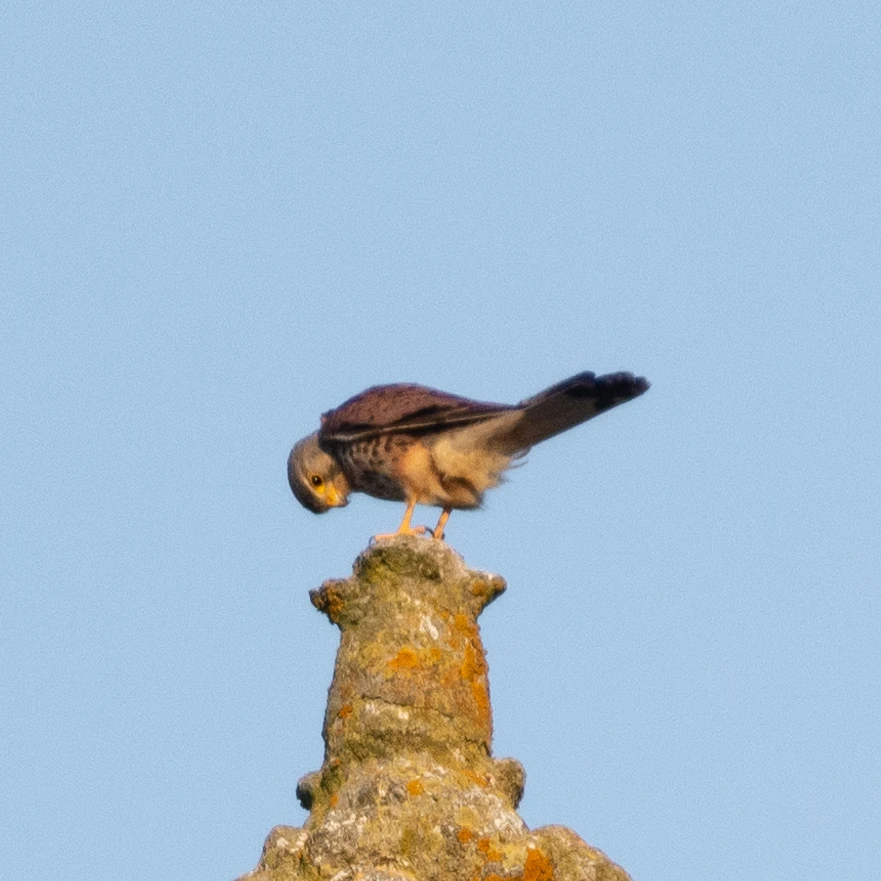
Compare plumage, posture, and field context across this image set.
About the Common Kestrel
The Common Kestrel (Falco tinnunculus) is a bird of prey widely recognized for its distinctive hovering flight while hunting. It plays a crucial ecological role as a predator of small mammals, particularly voles, helping to regulate rodent populations. This adaptable species is found across a vast range, encompassing Europe, Asia, and Africa, and has even colonized some oceanic islands. While not typically considered a bird of significant cultural importance, its presence is often associated with open landscapes and agricultural areas, making it a familiar sight to many.
Also known as: Eurasian Kestrel, European Kestrel.
Scientific classification
Phylum: Chordata
Clazz: Aves
Order: Falconiformes
Family: Falconidae
Genus: Falco
Species: Falco tinnunculus
Habitat and distribution
Adaptations: Kestrels are highly adaptable to various habitats. Their hunting style, which involves hovering and scanning the ground, is particularly effective in open areas. They can also utilize man-made structures like buildings and pylons for nesting and perching.
Variations: Numerous subspecies of the Common Kestrel are recognized, differing slightly in size, plumage coloration, and geographic distribution. For example, *Falco tinnunculus rupicolaeformis* is a subspecies found in parts of Africa.
Distribution: The Common Kestrel has one of the largest geographic ranges of any bird of prey. It is found throughout Europe, Asia, and Africa, extending from the northernmost parts of Scandinavia and Siberia to South Africa. It is also present on many Atlantic and Pacific islands. Migratory populations exist, with northern birds often moving south for the winter.
Habitat Types: Grasslands, Heathlands, Agricultural fields, Open woodlands, Urban areas, Coastal cliffs
Climate Zones: Temperate, Tropical, Subtropical, Boreal
Diet and feeding
Primary foods: Small mammals (especially voles), Insects (e.g., beetles, grasshoppers), Small birds, Lizards (in some regions)
Foraging behavior: The Common Kestrel is famous for its hunting technique of hovering in the air, facing into the wind, while scanning the ground for prey. It also hunts from perches, such as fence posts or trees. Once prey is spotted, it dives quickly to capture it.
Seasonal diet variations: Diet can vary seasonally depending on prey availability. In winter, when voles may be less active, kestrels may consume more insects or birds.
Specializations: Kestrels have excellent eyesight, allowing them to spot small prey from a considerable height. They are also able to see ultraviolet light, which helps them detect the urine trails of voles, leading them to areas with high prey density.
Reproduction and lifecycle
Breeding season: Typically spring and early summer (April-June in the Northern Hemisphere), but this can vary depending on location and climate.
Regional variations: Breeding season can be earlier in warmer southern regions and later in colder northern regions.
Courtship rituals: Courtship involves aerial displays by the male, including dives and calls. The male may also present food to the female.
Nest Type: Kestrels do not build their own nests. They use existing nests of other birds (e.g., crows), ledges on cliffs, or holes in trees or buildings.
Nesting Materials: No additional materials are typically added, they use the existing nest structure.
Parental care: The female incubates the eggs for about 27-30 days. The male provides food for the female during incubation and for the chicks after hatching. Both parents feed the chicks.
Fledging period: Chicks fledge (leave the nest) after about 27-32 days.
Clutch Size: Usually 3-6 eggs.
Physical characteristics
Sex-Based Plumage Differences: Females are generally slightly larger than males.
Length: 32-39 cm
Wingspan: 68-82 cm
Weight: 150-250 g
Lifespan: The average lifespan in the wild is around 2-4 years, although some individuals can live much longer. In captivity, they can live up to 15-20 years.
Breeding Plumage: There is little difference between breeding and non-breeding plumage, although breeding plumage may be slightly brighter.
Seasonal Feather Changes: Minimal seasonal variation; plumage may become slightly worn and faded over time.
Notable features: Pointed wings typical of falcons., Long tail, often fanned when hovering., Dark 'tear-mark' below the eye., Sharp talons for catching prey.
Interesting facts
Kestrels can see ultraviolet light.: This allows them to detect the urine trails of voles, which reflect UV light, making it easier to find their prey.
They are one of the most widespread birds of prey.: Their adaptability to different habitats and climates has allowed them to colonize a vast range across the globe.
Kestrels don't build nests: Kestrels are cavity nesters and will use old nests, cliffs and man-made structures.
Frequently asked questions
What is the main food of the Common Kestrel?
The main food is small mammals, particularly voles, although they also eat insects, birds, and lizards.
How can I tell the difference between a male and female kestrel?
Males have a grey head and tail, while females have a brown head and tail with more barring.
Are Common Kestrels endangered?
No, they are classified as Least Concern by the IUCN, meaning they are not currently considered to be at risk of extinction.
Do Kestrels migrate?
Populations in the northern hemisphere migrate south for the winter.
Compare the image, sound, habitat, and physical characteristics together when reviewing a sighting.