
The Common Chaffinch (*Fringilla coelebs*) is a widespread and familiar bird species found throughout Europe, North Africa, and parts of Western Asia. Known for its vibrant plumage, particularly in males, and its distinctive, ringing song, the Chaffinch plays an important ecological role as a seed disperser and insectivore. It's a highly adaptable species, thriving in a variety of habitats, from woodlands and hedgerows to parks and gardens. While not typically considered culturally significant in the same way as some iconic birds, its cheerful presence and song have made it a beloved garden visitor in many regions.
Photos of Common Chaffinch
Compare plumage, posture, and field context across this image set.
About the Common Chaffinch
The Common Chaffinch (*Fringilla coelebs*) is a widespread and familiar bird species found throughout Europe, North Africa, and parts of Western Asia. Known for its vibrant plumage, particularly in males, and its distinctive, ringing song, the Chaffinch plays an important ecological role as a seed disperser and insectivore. It's a highly adaptable species, thriving in a variety of habitats, from woodlands and hedgerows to parks and gardens. While not typically considered culturally significant in the same way as some iconic birds, its cheerful presence and song have made it a beloved garden visitor in many regions.
Also known as: Chaffinch.
Scientific classification
Phylum: Chordata
Clazz: Aves
Order: Passeriformes
Family: Fringillidae
Genus: Fringilla
Species: Fringilla coelebs
Habitat and distribution
Adaptations: Chaffinches exhibit generalist adaptations, allowing them to thrive in diverse environments. Their strong beaks are well-suited for cracking seeds, a primary food source, but they also readily consume insects, particularly during the breeding season. Their ability to utilize a wide range of food resources contributes to their success in various habitats.
Variations: Several subspecies of *Fringilla coelebs* are recognized, differing subtly in plumage coloration and size. For example, North African subspecies tend to have brighter blue-grey crowns than their European counterparts. Island populations, such as those in the Canary Islands, often show distinct morphological differences.
Distribution: The Common Chaffinch is found across Europe, North Africa (Morocco, Algeria, Tunisia), and western Asia, including Turkey, Iran, and parts of the Middle East. Some populations are migratory, moving south for the winter, while others are resident year-round. They have an altitudinal range from sea level to mountain forests, depending on the region.
Habitat Types: Woodlands, Hedgerows, Parks, Gardens, Farmland, Orchards
Climate Zones: Temperate, Mediterranean, Boreal
Diet and feeding
Primary foods: Seeds, Insects, Caterpillars, Berries
Foraging behavior: Chaffinches forage on the ground, often hopping and pecking for seeds and insects. They also glean insects from foliage and occasionally take berries. They are often seen at bird feeders, particularly during winter.
Seasonal diet variations: Diet shifts seasonally. Insects and caterpillars are a crucial part of the diet during the breeding season, providing protein for growing chicks. Seeds form the bulk of the diet during the non-breeding season.
Specializations: Their strong, conical bill is well-adapted for cracking open seeds of various sizes. While not highly specialized, their beak shape allows for efficient seed handling.
Reproduction and lifecycle
Breeding season: Typically from April to July in Europe, but may vary slightly depending on location and weather conditions.
Regional variations: Breeding may start earlier in warmer southern regions and later in cooler northern areas.
Courtship rituals: Males establish territories and attract females with a loud, distinctive song. They may also perform courtship displays, such as wing-fluttering and chasing.
Nest Type: Cup-shaped nest, well-concealed in a tree fork or bush.
Nesting Materials: Moss, Grass, Twigs, Spider silk, Animal hair
Parental care: The female primarily incubates the eggs, which hatch after about 11-13 days. Both parents feed the chicks, initially with insects and later with seeds. Chicks are altricial, meaning they are born helpless and require extensive parental care.
Fledging period: Chicks fledge (leave the nest) after approximately 13-14 days.
Clutch Size: Typically 4-5 eggs.
Physical characteristics
Sex-Based Plumage Differences: Minimal, males may be slightly larger
Length: 14-16 cm
Wingspan: 24.5-28.5 cm
Weight: 18-29 g
Lifespan: Typically 3 years in the wild, but can live longer (up to 14 years recorded).
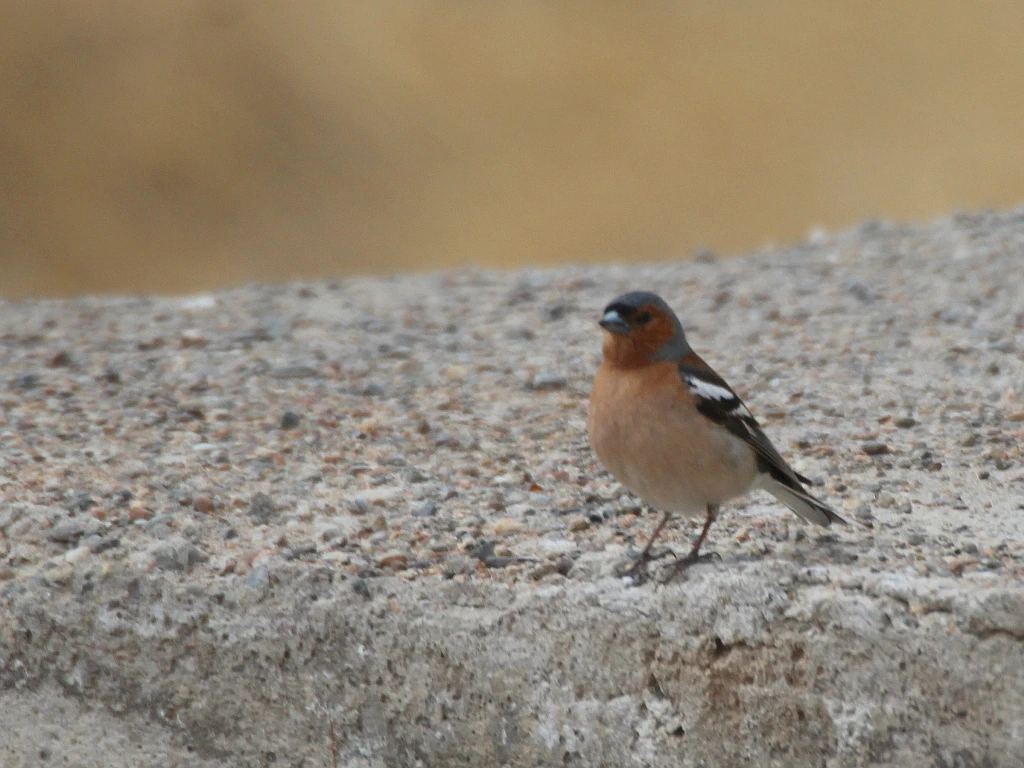
Breeding Plumage: Males have a distinctive blue-grey cap, rusty-pink breast and face, and black and white wing bars during the breeding season. Females are duller, with a more olive-brown and grey plumage. In non-breeding plumage, males become less vibrant, resembling females more closely.
Seasonal Feather Changes: The intensity of the male's breeding plumage fades after the breeding season. Molting occurs in late summer.
Notable features: White wing bars (prominent in flight), White outer tail feathers, Conical bill (typical of finches)
Interesting facts
The scientific name 'coelebs' means 'unmarried' or 'bachelor'.: Linnaeus gave this name because, in Sweden, he observed mostly male Chaffinches during winter, as females often migrate further south.
Chaffinches have regional 'dialects' in their songs.: The song structure can vary significantly between different geographic areas.
They can be quite bold and readily approach bird feeders.: This makes them a popular garden bird in many areas.
Frequently asked questions
What do Chaffinches eat?
Chaffinches eat a mix of seeds and insects. They feed their chicks primarily insects during the breeding season, and switch to a more seed-based diet in winter.
Where do Chaffinches build their nests?
Chaffinches build cup-shaped nests in trees or bushes, often well-concealed amongst foliage.
Are Chaffinches migratory?
Some Chaffinch populations are migratory, while others are resident. Migration patterns vary depending on location.
How can I tell the difference between a male and female Chaffinch?
Male Chaffinches have a blue-grey cap and a rusty-pink breast, while females are a duller olive-brown and grey.
Compare the image, sound, habitat, and physical characteristics together when reviewing a sighting.