
The Carolina Chickadee (Poecile carolinensis) is a small, non-migratory songbird native to the southeastern United States. It is a familiar sight at backyard feeders and is known for its distinctive 'chick-a-dee-dee-dee' call, from which it gets its name. This active and curious bird plays a vital role in controlling insect populations, particularly during the breeding season when it feeds caterpillars to its young. While not currently considered globally threatened, habitat loss and competition with other species can impact local populations. It holds no particular major cultural significance, other than being a well-loved backyard bird.
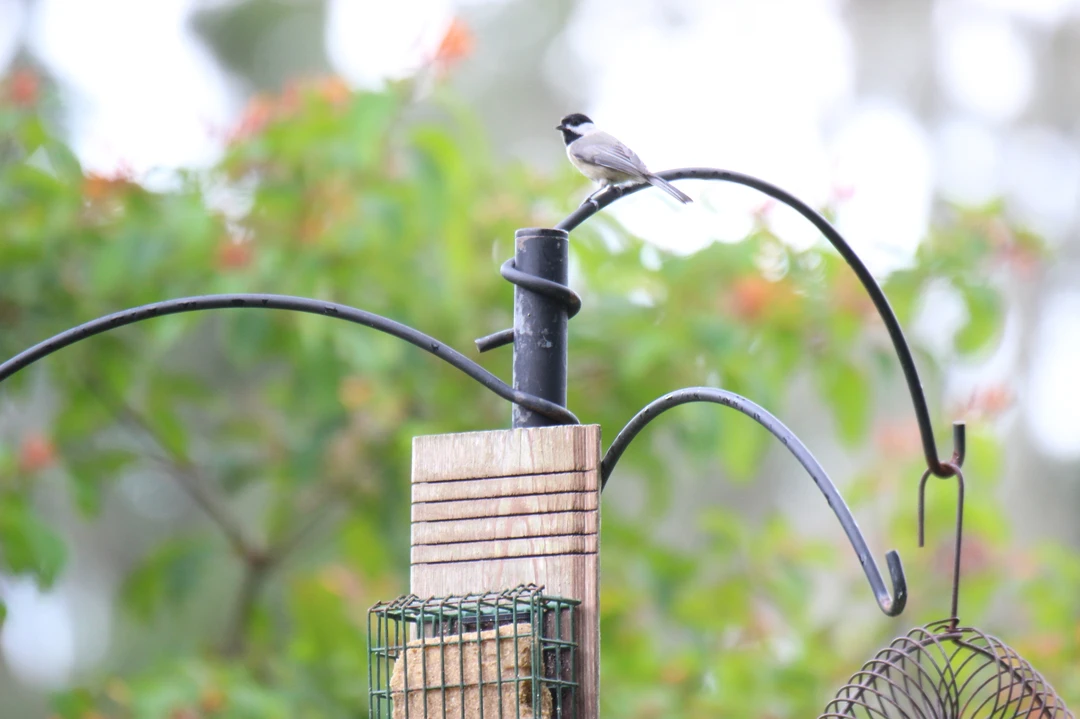
Photos of Carolina Chickadee
Compare plumage, posture, and field context across this image set.
Carolina Chickadee sounds
Listen to a small selection of reference recordings.
About the Carolina Chickadee
The Carolina Chickadee (Poecile carolinensis) is a small, non-migratory songbird native to the southeastern United States. It is a familiar sight at backyard feeders and is known for its distinctive 'chick-a-dee-dee-dee' call, from which it gets its name. This active and curious bird plays a vital role in controlling insect populations, particularly during the breeding season when it feeds caterpillars to its young. While not currently considered globally threatened, habitat loss and competition with other species can impact local populations. It holds no particular major cultural significance, other than being a well-loved backyard bird.
Scientific classification
Phylum: Chordata
Clazz: Aves
Order: Passeriformes
Family: Paridae
Genus: Poecile
Species: Poecile carolinensis
Habitat and distribution
Adaptations: Carolina Chickadees are well-adapted to human-altered landscapes, often thriving in suburban areas with sufficient tree cover and food sources. Their small size allows them to exploit a variety of food resources and nest sites.
Variations: Several subspecies of the Carolina Chickadee are recognized, based primarily on subtle differences in plumage color and size. These variations are often clinal, meaning they change gradually across the geographic range.
Distribution: The Carolina Chickadee is found exclusively in the southeastern United States. Its range extends from central Texas, Oklahoma, and Kansas eastward to the Atlantic coast, and from southern New Jersey southward to Florida. It has a limited altitudinal range as it is primarily a lowland species.
Habitat Types: Deciduous forests, Mixed woodlands, Forested wetlands, Suburban parks and gardens
Climate Zones: Temperate, Subtropical
Diet and feeding
Primary foods: Insects, Spiders, Seeds, Berries
Foraging behavior: Carolina Chickadees are active foragers, gleaning insects and spiders from leaves, branches, and tree bark. They often hang upside down to search the undersides of branches. They also visit bird feeders, particularly for sunflower seeds and suet.
Seasonal diet variations: Their diet shifts seasonally. During the breeding season, they primarily consume insects and spiders. In winter, they rely more on seeds and berries when insects are less abundant.
Specializations: Their small, pointed beaks are well-suited for probing crevices and extracting insects. They also cache food, storing seeds and insects in bark crevices and other hiding places for later retrieval.
Reproduction and lifecycle
Breeding season: Breeding typically occurs from late winter to early spring, varying slightly with latitude.
Regional variations: Birds in the southern part of the range may begin breeding earlier than those in the north.
Courtship rituals: Courtship involves the male feeding the female and engaging in vocal displays, including a 'fee-bee' song.
Nest Type: Cavity nester, using natural tree cavities or nest boxes.
Nesting Materials: Moss, Animal fur, Plant fibers
Parental care: Both parents incubate the eggs and feed the chicks. Incubation lasts about 12-15 days.
Fledging period: Chicks fledge (leave the nest) approximately 16-19 days after hatching.
Clutch Size: Typically 5-8 eggs.
Physical characteristics
Sex-Based Plumage Differences: Minimal
Length: 9.5-11.5 cm
Wingspan: 15-20 cm
Weight: 9-14 g
Lifespan: The average lifespan in the wild is 2-3 years, but some individuals can live up to 10 years.
Breeding Plumage: Plumage is similar year-round.
Seasonal Feather Changes: No significant seasonal variations.
Notable features: Black cap and bib, White cheeks, Gray back, wings, and tail, Buffy flanks
Interesting facts
They have excellent spatial memory: Carolina Chickadees can remember the locations of thousands of food caches, allowing them to survive harsh winters.
The number of 'dees' in their call indicates threat level: More 'dees' in the 'chick-a-dee' call signal a higher level of threat from a predator.
They can lower their body temperature at night: Carolina Chickadees can enter a state of regulated hypothermia, called torpor, to conserve energy during cold nights.
Frequently asked questions
How can I attract Carolina Chickadees to my yard?
Provide a source of fresh water, offer sunflower seeds and suet in feeders, and plant native trees and shrubs that provide food and shelter.
What is the difference between a Carolina Chickadee and a Black-capped Chickadee?
The two species are very similar in appearance. The Carolina Chickadee has less white on the edges of its wing feathers and a slightly faster, higher-pitched call. Their ranges overlap in a narrow zone, where hybridization can occur.
Do Carolina Chickadees reuse their nests?
While they may use the same cavity in subsequent years, they typically build a new nest each breeding season.
Compare the image, sound, habitat, and physical characteristics together when reviewing a sighting.