
The Canada Jay (Perisoreus canadensis), also known as the Gray Jay or Whiskey Jack, is a remarkably hardy and intelligent bird found in the boreal and subalpine forests of North America. Known for their bold and curious nature, these jays are year-round residents in some of the continent's coldest climates. They play a crucial role in their ecosystem, dispersing seeds and contributing to forest regeneration. The Canada Jay has also held cultural significance, appearing in Indigenous folklore and often associated with wilderness and winter survival.
Photos of Canada Jay
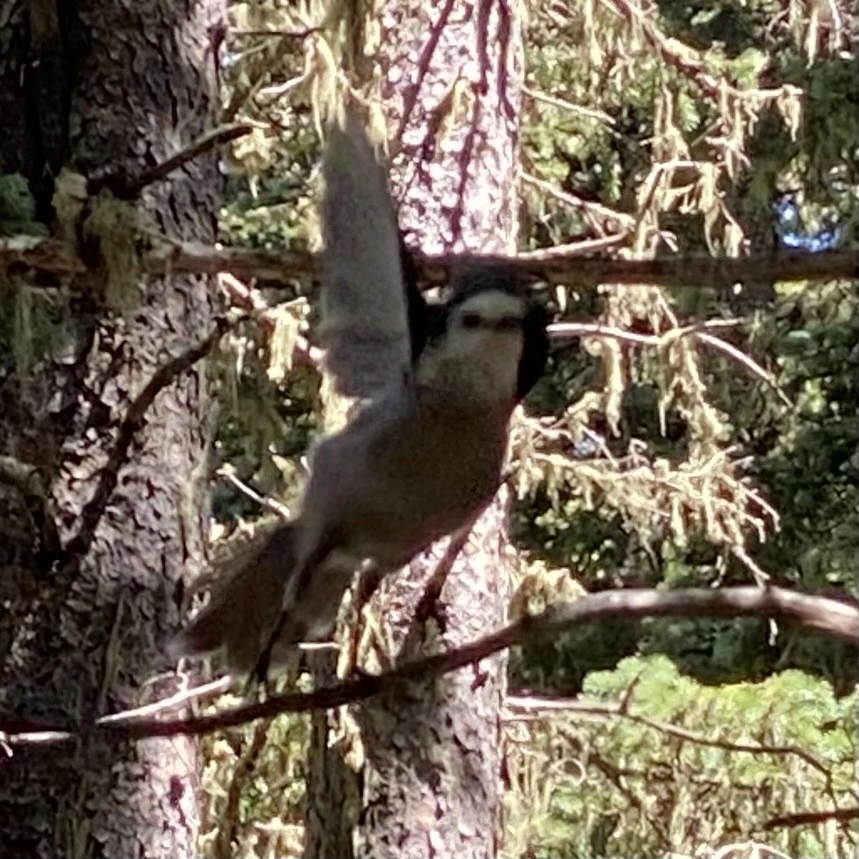
Compare plumage, posture, and field context across this image set.
Canada Jay sounds
Listen to a small selection of reference recordings.
About the Canada Jay
The Canada Jay (Perisoreus canadensis), also known as the Gray Jay or Whiskey Jack, is a remarkably hardy and intelligent bird found in the boreal and subalpine forests of North America. Known for their bold and curious nature, these jays are year-round residents in some of the continent's coldest climates. They play a crucial role in their ecosystem, dispersing seeds and contributing to forest regeneration. The Canada Jay has also held cultural significance, appearing in Indigenous folklore and often associated with wilderness and winter survival.
Also known as: Gray Jay, Grey Jay, Whiskeyjack, Camp Robber, Moosebird, Whiskey Jack, Gorby, Gorbey, Whisky-John, grease bird, venison hawk.
Scientific classification
Phylum: Chordata
Clazz: Aves
Order: Passeriformes
Family: Corvidae
Genus: Perisoreus
Species: Perisoreus canadensis
Habitat and distribution
Adaptations: Canada Jays possess several adaptations for cold climates, including dense, fluffy plumage for insulation and a remarkable ability to store and retrieve cached food. Their saliva is sticky, helping them glue food items to branches for later consumption.
Variations: Several subspecies of Canada Jay are recognized, exhibiting slight variations in plumage coloration and size across their geographic range. These variations are often subtle and may require expert observation to distinguish.
Distribution: The Canada Jay's range extends across North America, from Alaska and northern Canada, southward along the Rocky Mountains to New Mexico, and across the boreal forests to the northeastern United States and eastern Canada. They are non-migratory, remaining in their territories year-round.
Habitat Types: Boreal forests, Subalpine forests, Coniferous forests, Mixed woodlands (with a significant conifer component)
Climate Zones: Boreal, Subarctic, Temperate (in higher elevations)
Diet and feeding
Primary foods: Insects, Spiders, Berries, Seeds, Fungi, Small vertebrates (occasionally), Carrion
Foraging behavior: Canada Jays are opportunistic omnivores, foraging in trees and on the ground. They are known for their caching behavior, storing food items in various locations throughout their territory to retrieve during leaner times. They are also known to boldly approach humans for food.
Seasonal diet variations: During the breeding season (late winter/early spring), they rely heavily on cached food. In summer and fall, they consume a greater proportion of fresh insects, berries, and other readily available foods.
Specializations: Their sticky saliva aids in adhering food to tree bark and branches. They have an excellent spatial memory, allowing them to remember the locations of thousands of cached food items.
Reproduction and lifecycle
Breeding season: Late winter to early spring (February-April), remarkably early considering their northern habitat.
Regional variations: Breeding may be slightly earlier in the southern parts of their range.
Courtship rituals: Courtship involves mutual feeding, soft vocalizations, and allopreening (grooming each other's feathers).
Nest Type: Bulky cup nest, typically built in a conifer tree.
Nesting Materials: Twigs, Bark strips, Lichen, Spider silk, Animal fur
Parental care: Both parents incubate the eggs (for about 18-22 days) and feed the chicks. The young are altricial (helpless at hatching).
Fledging period: Approximately 22-24 days until fledging.
Clutch Size: 2-5 eggs
Physical characteristics
Sex-Based Plumage Differences: Minimal
Length: 25-33 cm
Wingspan: 45 cm
Weight: 65-85 g
Lifespan: The average lifespan in the wild is around 8 years, but some individuals have been recorded living up to 17 years.
Breeding Plumage: Plumage is generally consistent year-round.
Seasonal Feather Changes: No significant seasonal variations.
Notable features: Dark gray back and wings, White head with a black nape and partial eye mask, Grayish-white underparts, Relatively short, rounded wings
Interesting facts
They can remember the locations of thousands of food caches.: This remarkable spatial memory is crucial for their survival during winter.
Their nickname "Whiskey Jack" is an anglicization of the Algonquin name Wisakedjak.: Wisakedjak is a benevolent trickster figure in Algonquin folklore.
They start nesting very early, sometimes when snow is still deep on the ground.: This early nesting may be an adaptation to take advantage of cached food resources before other species become active.
They are known for their boldness and curiosity, often approaching humans closely.: This behavior, while endearing, can also make them vulnerable to human-related dangers.
Frequently asked questions
Are Canada Jays related to Blue Jays?
Yes, both Canada Jays and Blue Jays are members of the Corvidae family, which also includes crows, ravens, and magpies.
Do Canada Jays migrate?
No, Canada Jays are year-round residents in their territories.
What should I do if I find a baby Canada Jay?
It's best to leave it alone unless it's in immediate danger. The parents are likely nearby and will continue to care for it. If you are concerned, contact a local wildlife rehabilitator. Consult a professional for medical or expert advice
What do they use their sticky saliva for?
They use their sticky saliva to glue food items to branches, which creates long-lasting food caches that are resistent to weather and other animals.
How can I help Canada Jay conservation?
Supporting organizations that conserve boreal forest habitat and advocating for responsible forestry practices can help protect Canada Jays.
Compare the image, sound, habitat, and physical characteristics together when reviewing a sighting.