
The Budgerigar (Melopsittacus undulatus), commonly known as the 'budgie,' is a small, long-tailed, seed-eating parrot. Wild budgerigars are found throughout the drier parts of Australia, where they have survived harsh inland conditions for over five million years. They are naturally green and yellow with black, scalloped markings on the nape, back, and wings, but in captivity, they have been bred to display a variety of colors, including blue, white, yellow, and grey. Their small size, vibrant colors, and ability to mimic human speech have made them popular pets worldwide. Ecologically, budgerigars play a role in seed dispersal and are an important prey species for larger birds and reptiles.
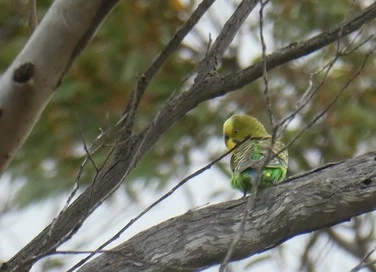
Photos of Budgerigar
Compare plumage, posture, and field context across this image set.
Budgerigar sounds
Listen to a small selection of reference recordings.
About the Budgerigar
The Budgerigar (Melopsittacus undulatus), commonly known as the 'budgie,' is a small, long-tailed, seed-eating parrot. Wild budgerigars are found throughout the drier parts of Australia, where they have survived harsh inland conditions for over five million years. They are naturally green and yellow with black, scalloped markings on the nape, back, and wings, but in captivity, they have been bred to display a variety of colors, including blue, white, yellow, and grey. Their small size, vibrant colors, and ability to mimic human speech have made them popular pets worldwide. Ecologically, budgerigars play a role in seed dispersal and are an important prey species for larger birds and reptiles.
Also known as: Budgie, Common Parakeet, Grass Parakeet, Warbling Grass Parakeet, Bush Budgie, Betcherrygah.
Scientific classification
Phylum: Chordata
Clazz: Aves
Order: Psittaciformes
Family: Psittacidae
Genus: Melopsittacus
Species: Melopsittacus undulatus
Habitat and distribution
Adaptations: Budgerigars are well-adapted to dry environments. They can obtain much of their water needs from their food (seeds) and have efficient kidneys to conserve water. Their nomadic behavior allows them to exploit patchy and unpredictable resources.
Variations: While no formally recognized subspecies exist, slight variations in size and plumage intensity have been observed across different regions of Australia, likely due to local environmental conditions.
Distribution: Native to Australia, budgerigars are widely distributed across the continent's interior, particularly in arid and semi-arid regions. They are nomadic, moving in response to the availability of food and water. While not typically migratory in the classic sense of fixed seasonal routes, their movements can cover large distances.
Habitat Types: Grasslands, Savannas, Open woodlands, Shrublands
Climate Zones: Arid, Semi-arid, Temperate (in some coastal areas)
Diet and feeding
Primary foods: Grass seeds, Seeds of herbaceous plants
Foraging behavior: Budgerigars primarily forage on the ground, often in large flocks. They are opportunistic feeders, taking advantage of available seed sources. They use their beaks to husk seeds efficiently.
Seasonal diet variations: Their diet varies depending on the availability of seeds, which is influenced by rainfall and the seasonal growth of grasses and other plants. During droughts, they may rely more on seeds from drought-resistant plants.
Specializations: Their strong, hooked beaks are well-suited for cracking open seeds. They also have a crop, a specialized part of the digestive system, that allows them to store food temporarily.
Reproduction and lifecycle
Breeding season: Breeding typically occurs after rainfall, which triggers the growth of food plants. In many parts of Australia, this can be any time of year.
Regional variations: Breeding is more opportunistic than strictly seasonal and is tied directly to rainfall patterns, which vary across the continent.
Courtship rituals: Courtship involves the male feeding the female, bobbing his head, and vocalizing with chirps and whistles. The male may also dilate his pupils.
Nest Type: Budgerigars nest in tree hollows, fence posts, or even logs lying on the ground.
Nesting Materials: Wood dust, Decayed wood
Parental care: The female incubates the eggs for about 18 days. Both parents feed the chicks by regurgitating food. The chicks are altricial, meaning they are born helpless and require extensive parental care.
Fledging period: Approximately 30-35 days until first flight.
Clutch Size: Typically 4-8 eggs
Physical characteristics
Sex-Based Plumage Differences: Minimal
Length: 18-20 cm
Wingspan: 25-30 cm
Weight: 30-40 g
Lifespan: In the wild, budgerigars typically live for 3-6 years. In captivity, with proper care, they can live for 7-15 years.
Breeding Plumage: Wild-type budgerigars have green underparts, yellow upperparts, and black scalloped markings. Captive-bred varieties exhibit a wide range of colors. There's no significant difference between breeding and non-breeding plumage.
Seasonal Feather Changes: No significant seasonal variation.
Notable features: Undulating flight pattern, Prominent cere, Long, tapered tail feathers
Interesting facts
Budgerigars can see ultraviolet light.: This ability likely helps them find food and mates, as some seeds and feathers reflect UV light.
They grind their beaks to keep them in good condition.: This behavior, often heard as a quiet clicking sound, helps to wear down the beak and prevent overgrowth.
Budgerigars have monocular vision.: Their eyes are positioned on the sides of their heads, giving them a wide field of view but limited depth perception.
They are one of the few parrot species that can be reliably sexed visually.: The color of the cere (the fleshy area above the beak) differs between adult males and females.
Frequently asked questions
Can budgerigars talk?
Yes, budgerigars are capable of mimicking human speech, although their vocabulary is typically smaller than that of larger parrots. Males are generally better talkers than females.
What is the difference between a budgie and a parakeet?
Budgerigar is the specific name for *Melopsittacus undulatus*. 'Parakeet' is a general term for many small to medium-sized parrot species with long tail feathers.
Are budgerigars good pets?
Budgerigars can make excellent pets due to their small size, social nature, and ability to bond with their owners. They require proper care, including a spacious cage, a balanced diet, and social interaction.
Do budgies need a companion?
While they are very social, a single budgie can thrive with enough human attention. However, if left alone for long periods, a companion budgie is recommended.
How can I tell if my budgie is healthy?
Healthy budgies are active, alert, and have smooth feathers. Signs of illness include lethargy, fluffed-up feathers, discharge from the eyes or nostrils, and changes in droppings. Consult a veterinarian specializing in birds for medical advice.
Compare the image, sound, habitat, and physical characteristics together when reviewing a sighting.