
The Boat-tailed Grackle (Quiscalus major) is a large, striking blackbird found primarily in the southeastern United States, particularly along coastal areas. Known for their distinctive, keel-shaped tail, these birds are highly social and often form large, noisy flocks. They play a significant ecological role as both predators and seed dispersers, contributing to the balance of their coastal ecosystems. Culturally, they are sometimes viewed as a nuisance due to their bold behavior and tendency to raid crops, but they are also admired for their intelligence and adaptability.
Photos of Boat-tailed Grackle
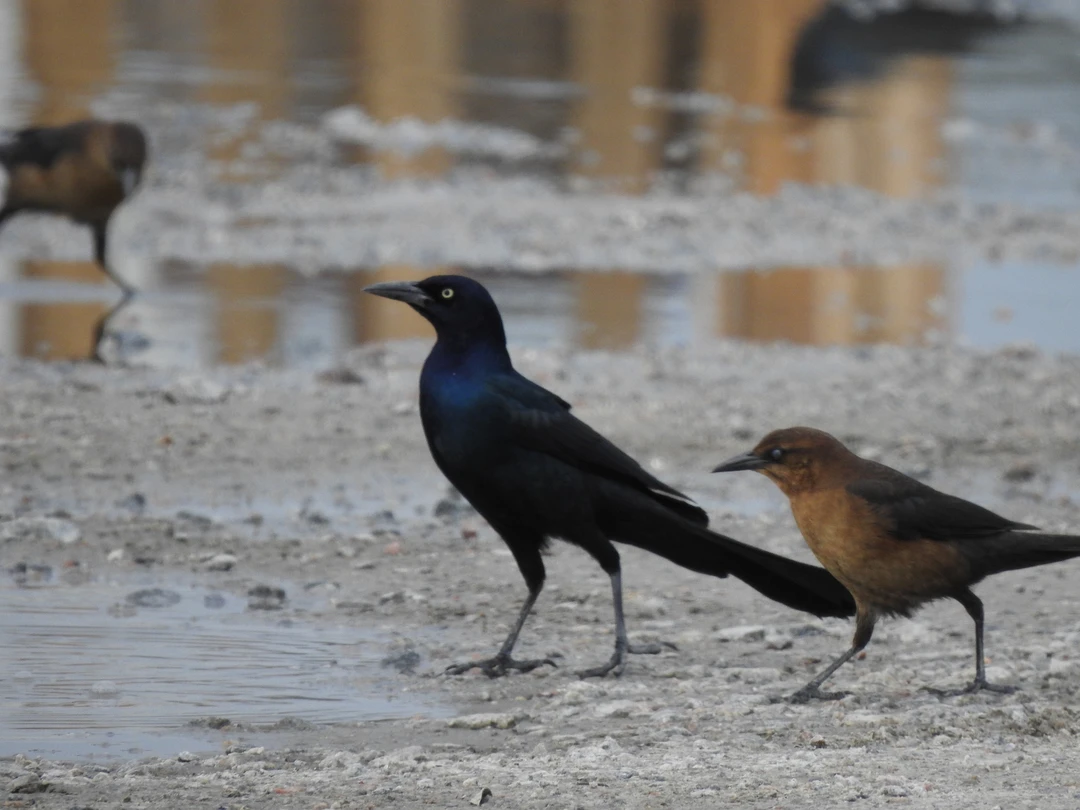
Compare plumage, posture, and field context across this image set.
Boat-tailed Grackle sounds
Listen to a small selection of reference recordings.
About the Boat-tailed Grackle
The Boat-tailed Grackle (Quiscalus major) is a large, striking blackbird found primarily in the southeastern United States, particularly along coastal areas. Known for their distinctive, keel-shaped tail, these birds are highly social and often form large, noisy flocks. They play a significant ecological role as both predators and seed dispersers, contributing to the balance of their coastal ecosystems. Culturally, they are sometimes viewed as a nuisance due to their bold behavior and tendency to raid crops, but they are also admired for their intelligence and adaptability.
Scientific classification
Phylum: Chordata
Clazz: Aves
Order: Passeriformes
Family: Icteridae
Genus: Quiscalus
Species: Quiscalus major
Habitat and distribution
Adaptations: Boat-tailed Grackles are well-adapted to coastal environments. They have strong legs and feet for walking on uneven terrain and foraging in mud and shallow water. Their long bills are useful for probing for food in a variety of substrates.
Variations: Several subspecies are recognized, differing primarily in size and bill shape. For example, coastal populations tend to have larger bills than inland populations.
Distribution: Primarily found along the Atlantic and Gulf coasts of the United States, from New York down to Florida and west to Texas. Some populations are also found in inland areas near large bodies of water.
Habitat Types: Salt marshes, Coastal scrub, Mangrove swamps, Estuaries, Agricultural fields (near the coast)
Climate Zones: Temperate, Subtropical
Diet and feeding
Primary foods: Insects, Crustaceans, Small fish, Seeds, Grains, Berries
Foraging behavior: Boat-tailed Grackles are opportunistic omnivores. They forage on the ground, in shallow water, and in vegetation. They often probe mud and sand with their bills, and they are known to wade into water to catch small fish and crustaceans. They also glean insects from plants and readily consume seeds and grains.
Seasonal diet variations: Diet varies depending on food availability. During the breeding season, they may consume more insects and other invertebrates to provide protein for their young. In the winter, they may rely more on seeds and grains.
Specializations: Their long bill is a versatile tool for probing and capturing a variety of prey items. They are also adept at manipulating objects with their feet.
Reproduction and lifecycle
Breeding season: Generally from late February to July, with peak activity in spring.
Regional variations: Breeding season can vary slightly depending on latitude, with southern populations breeding earlier.
Courtship rituals: Males display by puffing up their feathers, spreading their tails, and giving loud, rasping calls. They may also engage in chases and fights with other males.
Nest Type: A bulky, cup-shaped nest often built in colonies.
Nesting Materials: Marsh grasses, Twigs, Mud, Cattails
Parental care: Primarily the female incubates the eggs, although the male may assist in feeding the young. Both parents feed the chicks.
Fledging period: Approximately 2-3 weeks after hatching.
Clutch Size: Typically 2-4 eggs.
Physical characteristics
Sex-Based Plumage Differences: Males are significantly larger than females.
Length: 37-43 cm
Wingspan: 44-56 cm
Weight: 90-230 g
Lifespan: Up to 14 years in the wild, though most live considerably shorter lives. Captive birds can live longer.
Breeding Plumage: Little seasonal variation in plumage. Males are glossy black with a purple-blue iridescence. Females are a duller brownish-bronze color.
Seasonal Feather Changes: Minimal seasonal changes.
Notable features: Long, keel-shaped tail (more pronounced in males), Bright yellow eyes in adults, Long, pointed bill
Interesting facts
The 'boat-tail' is much more pronounced in males.: This feature is used in courtship displays to attract females.
Females are significantly smaller than males.: This is an example of sexual dimorphism, common in many bird species.
They are known for their intelligence and adaptability.: They have learned to exploit a variety of food sources and can thrive in human-altered environments.
Frequently asked questions
Are Boat-tailed Grackles aggressive?
Males can be aggressive during the breeding season when defending their territories. Otherwise, they are generally not aggressive towards humans, although they can be bold in their search for food.
What is the difference between a Boat-tailed Grackle and a Common Grackle?
Boat-tailed Grackles are larger, have a longer, keel-shaped tail, and are primarily found in coastal areas. Common Grackles have a shorter, flatter tail and a wider distribution.
Do Boat-tailed Grackles migrate?
Most populations are non-migratory, but some northernmost populations may move short distances south in winter.
What eats boat-tailed grackles?
Predators of Boat-tailed Grackles include birds of prey like hawks and owls, as well as snakes, raccoons, and other animals that may prey on eggs or nestlings.
Compare the image, sound, habitat, and physical characteristics together when reviewing a sighting.