
The Blue Jay (Cyanocitta cristata) is a strikingly beautiful and intelligent bird native to North America. Known for its vibrant blue, black, and white plumage, and its assertive, noisy calls, the Blue Jay plays a significant role in its ecosystem. It is an important disperser of seeds, particularly acorns, contributing to oak forest regeneration. Beyond its ecological role, the Blue Jay's intelligence and complex social behaviors have fascinated ornithologists and bird enthusiasts alike. It is also known for mimicking the calls of hawks, possibly to warn other jays or to deceive other species.
Photos of Blue Jay
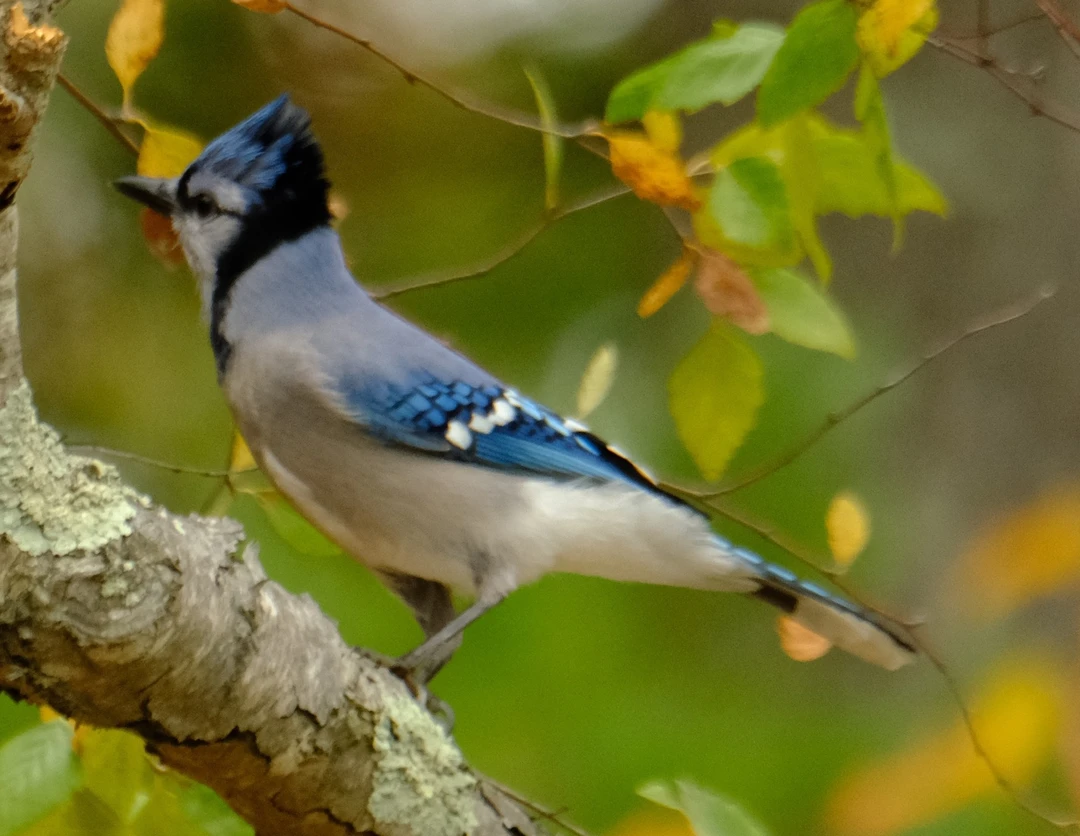
Compare plumage, posture, and field context across this image set.
Blue Jay sounds
Listen to a small selection of reference recordings.
About the Blue Jay
The Blue Jay (Cyanocitta cristata) is a strikingly beautiful and intelligent bird native to North America. Known for its vibrant blue, black, and white plumage, and its assertive, noisy calls, the Blue Jay plays a significant role in its ecosystem. It is an important disperser of seeds, particularly acorns, contributing to oak forest regeneration. Beyond its ecological role, the Blue Jay's intelligence and complex social behaviors have fascinated ornithologists and bird enthusiasts alike. It is also known for mimicking the calls of hawks, possibly to warn other jays or to deceive other species.
Also known as: Jay-bird.
Scientific classification
Phylum: Chordata
Clazz: Aves
Order: Passeriformes
Family: Corvidae
Genus: Cyanocitta
Species: Cyanocitta cristata
Habitat and distribution
Adaptations: Blue Jays are highly adaptable to various habitats, thriving in both forested and human-altered environments. Their robust bills are well-suited for cracking nuts and acorns, a key food source.
Variations: Several subspecies have been described, differing slightly in size and plumage intensity, primarily based on geographic location. These differences are generally subtle.
Distribution: Eastern and central North America, ranging from southern Canada to the Gulf Coast, and extending westward to the eastern edge of the Rocky Mountains. Some populations are resident, while others, particularly in the northern part of the range, migrate south for the winter.
Habitat Types: Mixed woodlands, Oak forests, Parks, Residential areas, Suburban gardens
Climate Zones: Temperate, Subtropical
Diet and feeding
Primary foods: Nuts (especially acorns), Seeds, Insects, Small invertebrates, Fruits, Grains
Foraging behavior: Blue Jays forage on the ground and in trees, often caching food (especially nuts) in hidden locations for later retrieval. They are known to be opportunistic feeders and may occasionally take eggs or nestlings of other birds.
Seasonal diet variations: Diet varies seasonally, with a greater reliance on insects during the breeding season and more nuts and seeds during the fall and winter.
Specializations: Their strong bill is adapted for cracking open hard-shelled nuts. They also have excellent spatial memory, allowing them to remember the locations of cached food items.
Reproduction and lifecycle
Breeding season: Typically from March to July, with variations depending on latitude.
Regional variations: Breeding may start earlier in the southern part of their range.
Courtship rituals: Courtship involves displays such as head-bobbing, fluffing of feathers, and offering food to the potential mate. Pairs are generally monogamous.
Nest Type: Cup-shaped nest built in a tree or large shrub.
Nesting Materials: Twigs, Grass, Leaves, Moss, Mud, Paper
Parental care: Both parents participate in nest building, incubation, and feeding the young. Incubation lasts about 17-18 days.
Fledging period: Young birds typically fledge (leave the nest) 17-21 days after hatching.
Clutch Size: Typically 2-7 eggs.
Physical characteristics
Sex-Based Plumage Differences: Minimal
Length: 22-30 cm
Wingspan: 34-43 cm
Weight: 70-100 g
Lifespan: Average lifespan in the wild is about 7 years, but some individuals have been recorded living over 15 years in captivity.
Breeding Plumage: Plumage is similar year-round, with no significant differences between breeding and non-breeding seasons.
Seasonal Feather Changes: No Major Seasonal Variations
Notable features: Prominent blue crest, which can be raised or lowered depending on the bird's mood., Black 'necklace' across the throat., White and black barring on the wings and tail., Bright blue feathers, with the color resulting from structural coloration rather than pigment.
Interesting facts
Blue Jays are known for their intelligence and complex social systems.: They exhibit problem-solving skills and can recognize individual humans.
The blue color in their feathers is not due to pigment.: It's a structural color caused by the scattering of light through specialized feather structures.
They are excellent mimics.: They can imitate the calls of various hawk species, possibly to warn other jays or to scare away competitors.
They play a crucial role in forest ecosystems.: Their habit of caching acorns helps in the dispersal and regeneration of oak trees.
Frequently asked questions
Are Blue Jays aggressive?
Blue Jays can be assertive and may defend their territories, especially during nesting season. They are also known to mob potential predators, such as owls or hawks.
Do Blue Jays eat other birds' eggs?
While Blue Jays are omnivorous and opportunistic, predation on eggs and nestlings is not a major part of their diet. It occurs occasionally but is not as common as often portrayed.
Why do Blue Jays scream?
Blue Jays have a variety of vocalizations, including loud 'jay' calls, which can serve as alarm calls, territorial announcements, or communication within their social group.
How can I attract Blue Jays to my yard?
Providing a source of fresh water, planting oak trees, and offering peanuts, sunflower seeds, or suet in feeders can attract Blue Jays.
Compare the image, sound, habitat, and physical characteristics together when reviewing a sighting.