
The Black-headed Gull (Chroicocephalus ridibundus) is a small, elegant gull species widespread across Eurasia and parts of North America. It's known for its distinctive chocolate-brown hood during the breeding season, which fades to a dark smudge behind the eye in winter. This adaptable bird thrives in a variety of habitats, from coastal areas to inland wetlands and even agricultural fields. Ecologically, it plays a role in controlling insect populations and dispersing seeds. While not of major cultural significance, its presence is a familiar sight in many urban and rural environments, often scavenging for food near human activity.
Photos of Black-headed Gull
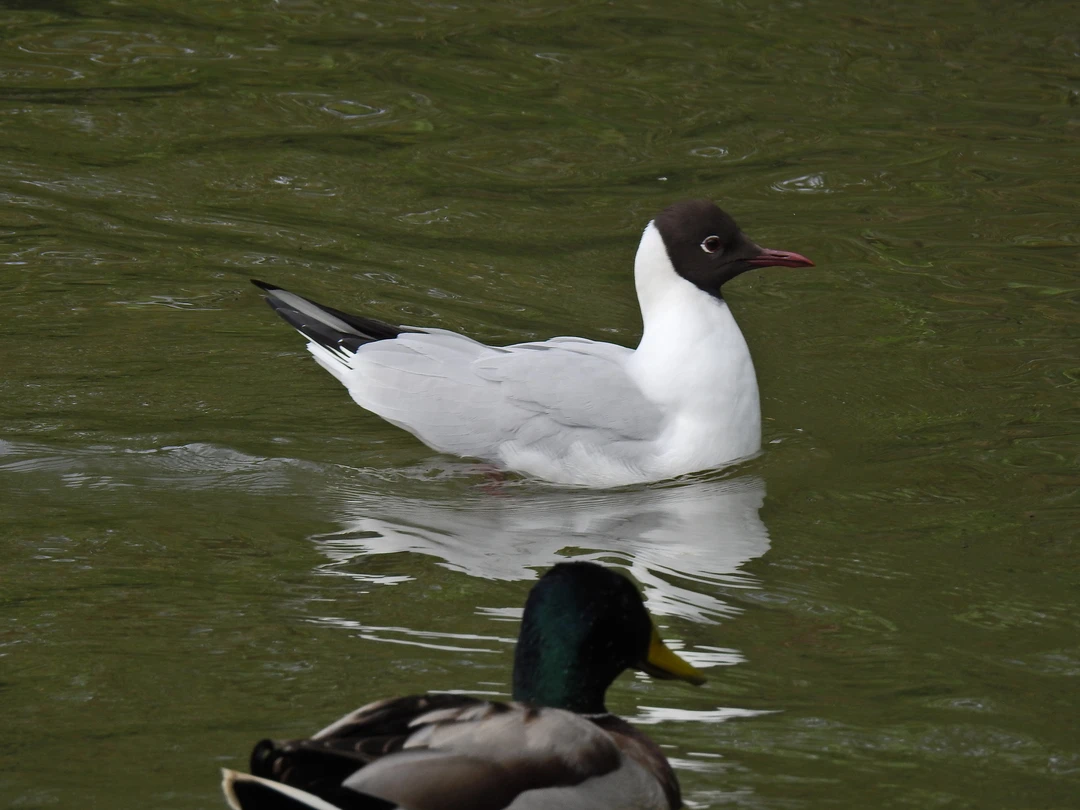
Compare plumage, posture, and field context across this image set.
Black-headed Gull sounds
Listen to a small selection of reference recordings.
About the Black-headed Gull
The Black-headed Gull (Chroicocephalus ridibundus) is a small, elegant gull species widespread across Eurasia and parts of North America. It's known for its distinctive chocolate-brown hood during the breeding season, which fades to a dark smudge behind the eye in winter. This adaptable bird thrives in a variety of habitats, from coastal areas to inland wetlands and even agricultural fields. Ecologically, it plays a role in controlling insect populations and dispersing seeds. While not of major cultural significance, its presence is a familiar sight in many urban and rural environments, often scavenging for food near human activity.
Also known as: Common Black-headed Gull.
Scientific classification
Phylum: Chordata
Clazz: Aves
Order: Charadriiformes
Family: Laridae
Genus: Chroicocephalus
Species: Chroicocephalus ridibundus
Habitat and distribution
Adaptations: Black-headed Gulls are highly adaptable to various food sources and habitat types. Their relatively small size and agile flight allow them to forage in diverse environments. They are also tolerant of human presence, often thriving in urban and suburban areas.
Variations: While generally considered monotypic (no recognized subspecies), some regional variations in size and plumage darkness have been noted, but these are not considered distinct enough to warrant subspecies classification.
Distribution: The Black-headed Gull breeds across much of Europe and Asia, extending from Iceland and the British Isles eastward to Kamchatka and northeastern China. It also has a small breeding population in eastern Canada. During the non-breeding season, it migrates south, reaching coastal regions of North Africa, the Middle East, South Asia, and Southeast Asia. Altitudinally, it ranges from sea level to about 1500 meters.
Habitat Types: Coastal areas, Estuaries, Inland wetlands, Lakes and ponds, Marshes, Rivers, Agricultural fields, Urban parks
Climate Zones: Temperate, Boreal, Subarctic
Diet and feeding
Primary foods: Insects, Worms, Small fish, Crustaceans, Mollusks, Seeds, Berries, Carrion, Human refuse
Foraging behavior: Black-headed Gulls are opportunistic feeders, employing a variety of foraging techniques. They may pick items from the ground, catch insects in flight, plunge-dive for fish, or scavenge for scraps. They often follow fishing boats or agricultural machinery to take advantage of disturbed prey.
Seasonal diet variations: Diet varies seasonally depending on prey availability. Insects are a major food source during the breeding season, while fish, crustaceans, and human refuse may be more important in winter.
Specializations: Their relatively slender bill is well-suited for catching small invertebrates and fish. They are also adept at aerial foraging, catching flying insects with agility.
Reproduction and lifecycle
Breeding season: The breeding season typically occurs from April to July in temperate regions.
Regional variations: Breeding may start slightly earlier in warmer, southern regions and later in colder, northern areas.
Courtship rituals: Courtship involves elaborate displays, including head-bobbing, calling, and synchronized flights. Pairs often engage in mutual preening and food-begging behavior.
Nest Type: A shallow scrape on the ground, often lined with vegetation.
Nesting Materials: Grass, Reeds, Twigs, Feathers
Parental care: Both parents share incubation duties, which last for about 23-26 days. Chicks are semi-precocial, meaning they are covered in down and can walk soon after hatching, but they remain in the nest and are fed by both parents. They are fiercely protective of their nests and young, and will mob potential predators.
Fledging period: Chicks fledge (take their first flight) at around 35-40 days old.
Clutch Size: Typically 2-3 eggs.
Physical characteristics
Sex-Based Plumage Differences: Minimal
Length: 34-43 cm
Wingspan: 86-99 cm
Weight: 190-400 g
Lifespan: The average lifespan in the wild is around 10-15 years, but some individuals have been recorded living over 30 years.
Breeding Plumage: Breeding adults have a distinctive chocolate-brown hood, white neck, and pale grey body. Non-breeding adults lose the hood, retaining only a dark smudge behind the eye. The legs and bill are red in breeding plumage, becoming duller in winter.
Seasonal Feather Changes: The most significant seasonal variation is the presence or absence of the brown hood. Juveniles have mottled brown and buff plumage, gradually acquiring adult plumage over 2-3 years.
Notable features: Chocolate-brown hood (breeding plumage), Dark smudge behind the eye (non-breeding plumage), Red legs and bill (brighter in breeding plumage), White outer primaries with black tips, Slender, pointed bill
Interesting facts
The 'black' head is actually a dark chocolate brown.: The color is only present during the breeding season; in winter, the head is mostly white with a dark smudge behind the eye.
They are known for their kleptoparasitic behavior.: They will often steal food from other birds, including other gulls and terns.
They can hybridize with other gull species.: Although rare, hybridization has been recorded with species like the Mediterranean Gull.
They are highly adaptable to urban environments.: They are commonly seen in cities and towns, scavenging for food in parks, landfills, and near human settlements.
Frequently asked questions
What is the difference between a Black-headed Gull and a Laughing Gull?
Laughing Gulls have a truly black head during breeding season and a distinctive 'laughing' call. Black-headed Gulls have a chocolate-brown hood and different vocalizations.
Are Black-headed Gulls aggressive?
They can be aggressive when defending their nests and young, but are generally not a threat to humans.
Do Black-headed Gulls mate for life?
They are generally monogamous during a breeding season, but pair bonds may not always last for life. Divorce and re-pairing can occur.
Why do I see so many Black-headed Gulls inland?
While they are often associated with coasts, Black-headed Gulls are highly adaptable and can thrive in a variety of inland habitats, including lakes, rivers, and agricultural fields, especially during migration and winter.
Compare the image, sound, habitat, and physical characteristics together when reviewing a sighting.