
The Barn Swallow (Hirundo rustica) is a widely recognized and beloved bird species, known for its graceful flight, distinctive forked tail, and close association with human environments. Found on nearly every continent, it plays a significant role in insect control, consuming vast quantities of flying insects. Culturally, the Barn Swallow is often seen as a symbol of spring, good luck, and long-distance travel, frequently appearing in folklore and literature.
Photos of Barn Swallow
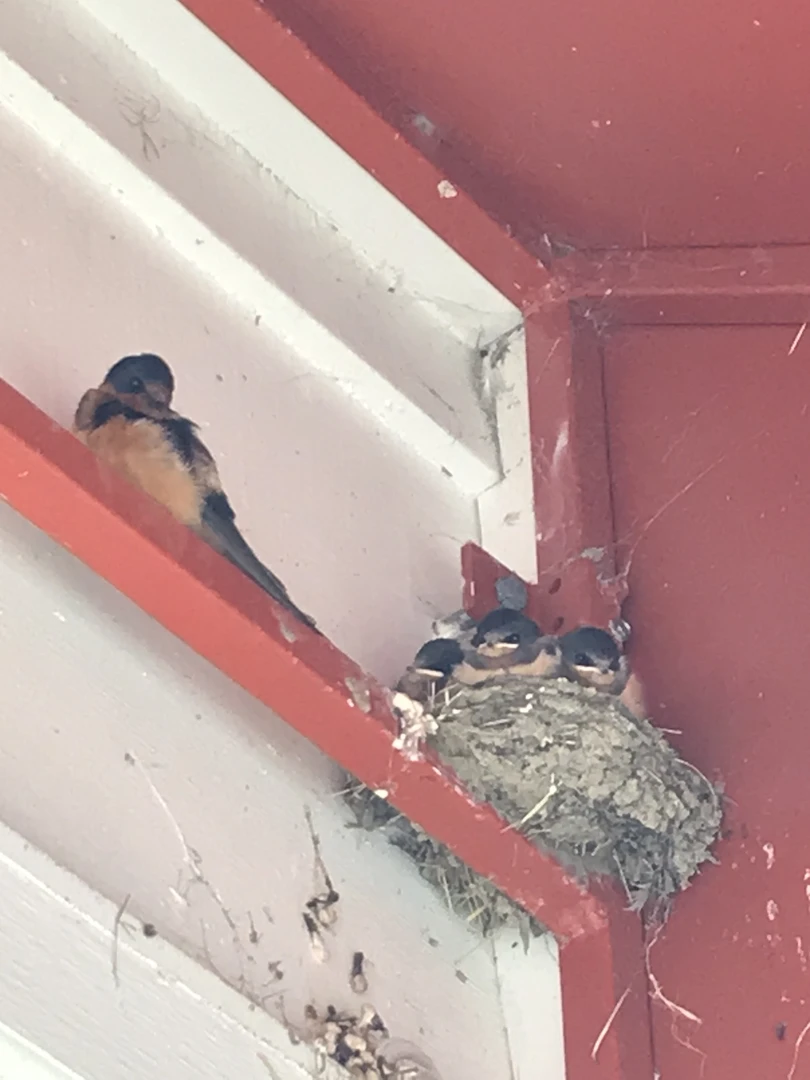
Compare plumage, posture, and field context across this image set.
Barn Swallow sounds
Listen to a small selection of reference recordings.
About the Barn Swallow
The Barn Swallow (Hirundo rustica) is a widely recognized and beloved bird species, known for its graceful flight, distinctive forked tail, and close association with human environments. Found on nearly every continent, it plays a significant role in insect control, consuming vast quantities of flying insects. Culturally, the Barn Swallow is often seen as a symbol of spring, good luck, and long-distance travel, frequently appearing in folklore and literature.
Also known as: European Swallow, Common Swallow.
Scientific classification
Phylum: Chordata
Clazz: Aves
Order: Passeriformes
Family: Hirundinidae
Genus: Hirundo
Species: Hirundo rustica
Habitat and distribution
Adaptations: Barn Swallows are highly adapted to aerial foraging, with long, pointed wings and a streamlined body. They are also well-adapted to living near humans, often building their nests on man-made structures.
Variations: Several subspecies are recognized, differing slightly in plumage color and size. For example, *Hirundo rustica rustica* (Europe) has a complete breast band, while *Hirundo rustica erythrogaster* (North America) often has an incomplete band.
Distribution: Barn Swallows have one of the largest ranges of any songbird. They breed across North America, Europe, Asia, and parts of North Africa. They are long-distance migrants, wintering in South America, sub-Saharan Africa, South Asia, and Australia. They can be found at a wide range of altitudes, from sea level to high mountain valleys.
Habitat Types: Open country, Farmland, Wetlands, Grasslands, Near human settlements
Climate Zones: Temperate, Tropical, Subtropical
Diet and feeding
Primary foods: Flying insects, Flies, Beetles, Moths, Bees, Wasps
Foraging behavior: Barn Swallows are aerial insectivores, catching their prey in flight. They often forage low over open fields, water, or other habitats where insects are abundant. They are agile fliers, capable of rapid turns and dives.
Seasonal diet variations: Diet is primarily dictated by insect availability. During the breeding season, they may focus on larger insects to feed their young. Dietary shifts may occur during migration depending on prey encountered.
Specializations: Their wide gape allows them to capture insects efficiently in mid-air. Their long, pointed wings enable sustained flight and maneuverability.
Reproduction and lifecycle
Breeding season: Generally spring and summer, varying with latitude. Northern populations breed later than southern populations.
Regional variations: In tropical regions, breeding may occur year-round or be tied to rainy seasons. Northern hemisphere breeding is generally April-August; southern hemisphere breeding is generally September-March.
Courtship rituals: Courtship involves aerial chases and displays, with males often spreading their tail feathers to show off their streamers. Males also sing to attract females.
Nest Type: Cup-shaped nest made of mud pellets.
Nesting Materials: Mud, Grass, Feathers, Hair
Parental care: Both parents incubate the eggs (13-17 days) and feed the chicks. Chicks are altricial (helpless at hatching) and require extensive parental care.
Fledging period: Approximately 20-24 days until first flight.
Clutch Size: Typically 3-7 eggs.
Physical characteristics
Sex-Based Plumage Differences: Males tend to have slightly longer tail streamers.
Length: 17-19 cm
Wingspan: 32-34.5 cm
Weight: 16-25 g
Lifespan: Typically 4 years in the wild, but some individuals have been recorded living up to 8 years.
Breeding Plumage: Plumage is generally similar year-round, but may be slightly duller in non-breeding season.
Seasonal Feather Changes: Fresh plumage after molting is more vibrant; wear and tear can make it appear duller.
Notable features: Deeply forked tail with elongated outer streamers., Glossy blue-black upperparts., Reddish-brown forehead, chin, and throat., Pale underparts (ranging from white to buffy, depending on subspecies).
Interesting facts
Barn Swallows often return to the same nesting site year after year.: This phenomenon is known as 'site fidelity.'
The length of a male Barn Swallow's tail streamers is thought to be an indicator of his health and genetic quality.: Females may prefer males with longer, more symmetrical streamers.
Barn Swallows can drink and bathe on the wing, skimming the surface of the water.: This allows them to stay airborne for extended periods.
They build their nests one mud pellet at a time: It can take over 1000 trips to gather enough mud.
Frequently asked questions
What should I do if I find a baby Barn Swallow?
If the bird is injured or appears to be in distress, contact a local wildlife rehabilitator. If it is uninjured and near its nest, it is best to leave it alone, as the parents are likely nearby.
How can I attract Barn Swallows to my property?
Provide open spaces with access to flying insects. A water source, like a pond or birdbath, can also be attractive. You can also provide a nesting platform, but be aware they prefer to build their own mud nests.
Are Barn Swallows beneficial to have around?
Yes, Barn Swallows are excellent natural pest control, consuming large numbers of flying insects, including mosquitoes and flies.
Do Barn Swallows mate for life?
Barn Swallows are typically seasonally monogamous, forming pair bonds for a single breeding season. However, some pairs may remain together for multiple years.
Compare the image, sound, habitat, and physical characteristics together when reviewing a sighting.