
The Baltimore Oriole (Icterus galbula) is a vibrant, medium-sized songbird known for its striking orange and black plumage, often considered a symbol of spring in eastern North America. This species plays a crucial role in controlling insect populations, particularly during the breeding season. It also has cultural significance, lending its name to the Baltimore Orioles Major League Baseball team due to the male's plumage resembling the colors on the coat-of-arms of Lord Baltimore.
Photos of Baltimore Oriole
Compare plumage, posture, and field context across this image set.
Baltimore Oriole sounds
Listen to a small selection of reference recordings.
About the Baltimore Oriole
The Baltimore Oriole (Icterus galbula) is a vibrant, medium-sized songbird known for its striking orange and black plumage, often considered a symbol of spring in eastern North America. This species plays a crucial role in controlling insect populations, particularly during the breeding season. It also has cultural significance, lending its name to the Baltimore Orioles Major League Baseball team due to the male's plumage resembling the colors on the coat-of-arms of Lord Baltimore.
Scientific classification
Phylum: Chordata
Clazz: Aves
Order: Passeriformes
Family: Icteridae
Genus: Icterus
Species: Icterus galbula
Habitat and distribution
Adaptations: Adaptable to a variety of wooded habitats, provided there are tall trees for nesting and a sufficient supply of insects and fruits. Their strong, pointed bills are well-suited for both gleaning insects and probing flowers for nectar.
Variations: No recognized subspecies, but some slight variations in plumage brightness and size have been observed across their range.
Distribution: Breeds across eastern North America, from southeastern Canada to the central and southeastern United States. Winters in Central America, northern South America, and the Caribbean.
Habitat Types: Deciduous forests, Open woodlands, Orchards, Parks, Suburban areas with scattered trees
Climate Zones: Temperate, Subtropical
Diet and feeding
Primary foods: Insects, Caterpillars, Fruits, Nectar, Spiders
Foraging behavior: Forages actively in trees and shrubs, gleaning insects from leaves and branches. Also probes flowers for nectar and eats fruits.
Seasonal diet variations: Diet shifts with the seasons. During the breeding season, they primarily eat insects, especially caterpillars. In the fall and winter, they consume more fruits and nectar.
Specializations: Their pointed bill is well-suited for probing into flowers and extracting insects from crevices. They are also adept at catching insects in flight.
Reproduction and lifecycle
Breeding season: May-July in most of their range.
Regional variations: Breeding season may start slightly earlier in the southern parts of their range.
Courtship rituals: Males perform courtship displays that involve singing, bowing, and spreading their wings and tail to show off their bright plumage. They may also chase females.
Nest Type: Pendant, pouch-like nest woven from plant fibers, hair, and other materials.
Nesting Materials: Plant fibers, Grass, Hair, String, Spider silk
Parental care: Primarily the female incubates the eggs for 11-14 days. Both parents feed the chicks, which fledge about 11-14 days after hatching.
Fledging period: 11-14 days.
Clutch Size: 3-7 eggs, typically 4-5.
Physical characteristics
Sex-Based Plumage Differences: Males are slightly larger than females.
Length: 17-22 cm
Wingspan: 23-32 cm
Weight: 28-48 g
Lifespan: Up to 11 years in the wild; longer in captivity (Not Evaluated).
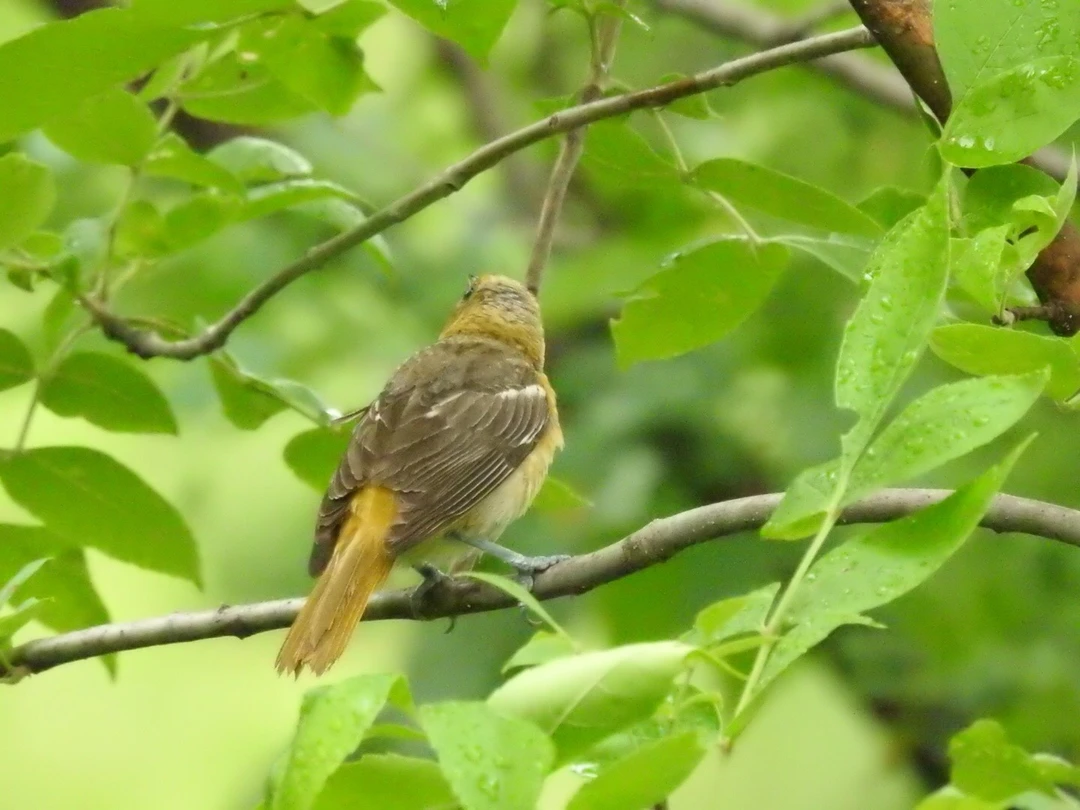
Breeding Plumage: Adult males have bright orange underparts, shoulders, and rump, with a black head, back, wings, and tail. Females and immature birds are duller, with yellowish-orange underparts and olive-brown upperparts. Non-breeding plumage is similar to breeding plumage, but may be slightly less vibrant.
Seasonal Feather Changes: Minor seasonal variations, primarily in the intensity of coloration.
Notable features: Bright orange and black plumage in adult males., Strong, pointed bill., White wing bars.
Interesting facts
Baltimore Orioles are known for their intricately woven nests.: These nests are suspended from branches, often high in trees, and are made of strong plant fibers.
They are named after Lord Baltimore.: The male's colors resemble those on Lord Baltimore's coat-of-arms.
Baltimore Orioles are attracted to oranges.: People often put out orange halves to attract them to their yards.
Frequently asked questions
What do Baltimore Orioles eat?
They eat insects, caterpillars, fruits, and nectar, with their diet varying seasonally.
Where do Baltimore Orioles nest?
They build hanging, pouch-like nests high in trees, often in deciduous forests or open woodlands.
Are Baltimore Orioles endangered?
No, they are classified as Least Concern by the IUCN.
How can I attract Baltimore Orioles to my yard?
Provide a source of fresh water, plant native trees and shrubs that produce fruits, and put out orange halves or grape jelly.
Compare the image, sound, habitat, and physical characteristics together when reviewing a sighting.