
The Acadian Flycatcher (*Empidonax virescens*) is a small, Neotropical migratory bird of the tyrant flycatcher family. It is known for its distinctive "peet-sah" song and preference for mature, deciduous forests with a well-developed understory and proximity to water. This species plays a crucial role in controlling insect populations within its forest habitat. While not globally threatened, it is considered a species of concern in some regions due to habitat loss and fragmentation. The Acadian Flycatcher is not particularly prominent in human culture, but its presence is a good indicator of healthy, mature forest ecosystems.
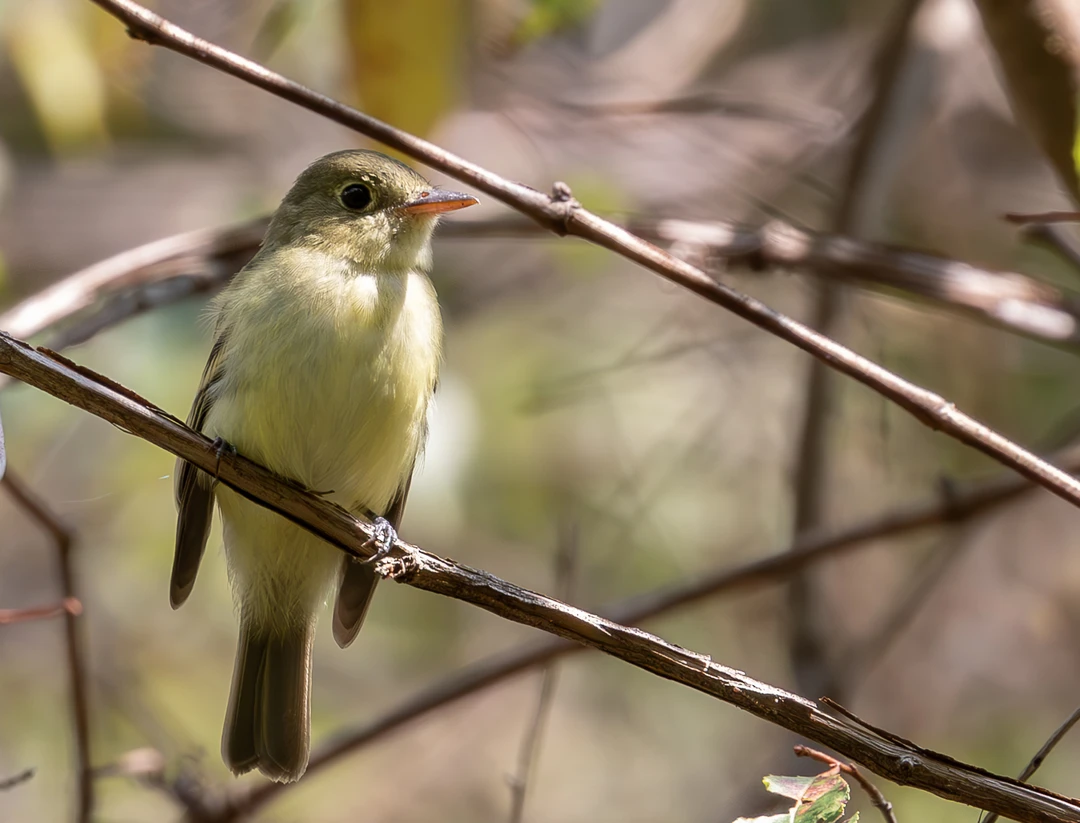
Photos of Acadian Flycatcher
Compare plumage, posture, and field context across this image set.
Acadian Flycatcher sounds
Listen to a small selection of reference recordings.
About the Acadian Flycatcher
The Acadian Flycatcher (*Empidonax virescens*) is a small, Neotropical migratory bird of the tyrant flycatcher family. It is known for its distinctive "peet-sah" song and preference for mature, deciduous forests with a well-developed understory and proximity to water. This species plays a crucial role in controlling insect populations within its forest habitat. While not globally threatened, it is considered a species of concern in some regions due to habitat loss and fragmentation. The Acadian Flycatcher is not particularly prominent in human culture, but its presence is a good indicator of healthy, mature forest ecosystems.
Also known as: Small Green-crested Flycatcher.
Scientific classification
Phylum: Chordata
Clazz: Aves
Order: Passeriformes
Family: Tyrannidae
Genus: Empidonax
Species: Empidonax virescens
Habitat and distribution
Adaptations: The Acadian Flycatcher's preference for forests with dense understories and proximity to water provides ample foraging opportunities and protection from predators. Their relatively long wings facilitate efficient long-distance migration.
Variations: No recognized subspecies exist, although slight variations in plumage and vocalizations may occur across the breeding range. These variations are not considered significant enough to warrant subspecies classification.
Distribution: The Acadian Flycatcher breeds across the eastern United States, ranging from southern New England and New York west to southern Minnesota and eastern Texas, and south to northern Florida. It winters in Central America and northern South America, primarily in countries like Nicaragua, Costa Rica, Panama, Colombia, and Venezuela. Migratory routes typically follow the Gulf Coast and across the Gulf of Mexico.
Habitat Types: Mature deciduous forests, Bottomland hardwood forests, Forested wetlands, Riparian corridors
Climate Zones: Temperate, Subtropical
Diet and feeding
Primary foods: Insects, Spiders, Small invertebrates
Foraging behavior: Acadian Flycatchers primarily employ a sit-and-wait foraging strategy. They perch on a branch, often in the mid-story of the forest, and sally out to catch flying insects in mid-air. They also glean insects and spiders from foliage.
Seasonal diet variations: Diet is primarily insectivorous throughout the year. During the breeding season, they may consume a higher proportion of larger insects to feed their young. On the wintering grounds, they may supplement their diet with small fruits when insect availability is low.
Specializations: Their relatively long, flat bill is well-suited for capturing flying insects. They have excellent aerial agility, allowing them to maneuver quickly and capture prey.
Reproduction and lifecycle
Breeding season: May-August in most of its breeding range.
Regional variations: Breeding may begin slightly earlier in the southern portions of the range.
Courtship rituals: Males establish territories and attract females with their distinctive "peet-sah" song. Courtship displays may involve short flights and chases, as well as wing-fluttering and tail-fanning.
Nest Type: A shallow, cup-shaped nest, often suspended from a forked branch.
Nesting Materials: Plant fibers, Spider silk, Grass, Twigs, Animal hair
Parental care: Both parents incubate the eggs for approximately 13-15 days. Both parents also feed the chicks, which fledge after about 13-15 days.
Fledging period: 13-15 days until first flight.
Clutch Size: Typically 2-3 eggs, occasionally 4.
Physical characteristics
Sex-Based Plumage Differences: Minimal
Length: 13-15 cm
Wingspan: 22-25 cm
Weight: 11-14 g
Lifespan: The average lifespan in the wild is not well-documented, but individuals have been known to live at least 8 years.
Breeding Plumage: Plumage remains relatively consistent throughout the year. Adults have olive-green upperparts, whitish underparts with a slight yellowish wash on the belly, and two white wing bars. The throat is white, and there is a faint white eye-ring.
Seasonal Feather Changes: Minimal seasonal variation.
Notable features: White eye-ring, Two white wing bars, Slightly peaked crown, Relatively long, flat bill
Interesting facts
They are known for their 'explosive' song.: The characteristic 'peet-sah' song is delivered with a forceful expulsion of air, making it sound louder than expected for such a small bird.
They often reuse the same nesting territory year after year.: This site fidelity suggests the importance of specific habitat characteristics for successful breeding.
They can hover like a hummingbird: This flight adaptation is used during feeding.
Frequently asked questions
What is the best way to identify an Acadian Flycatcher?
Look for a small, olive-green flycatcher with a white eye-ring, two white wing bars, and a yellowish wash on the belly. Listen for its distinctive "peet-sah" song.
Where can I find Acadian Flycatchers?
Look for them in mature deciduous forests, especially those with a well-developed understory and proximity to water, during the breeding season (May-August).
Are Acadian Flycatchers endangered?
No, they are currently listed as a species of Least Concern by the IUCN. However, they are facing threats from habitat loss and degradation, so conservation efforts are important.
Compare the image, sound, habitat, and physical characteristics together when reviewing a sighting.